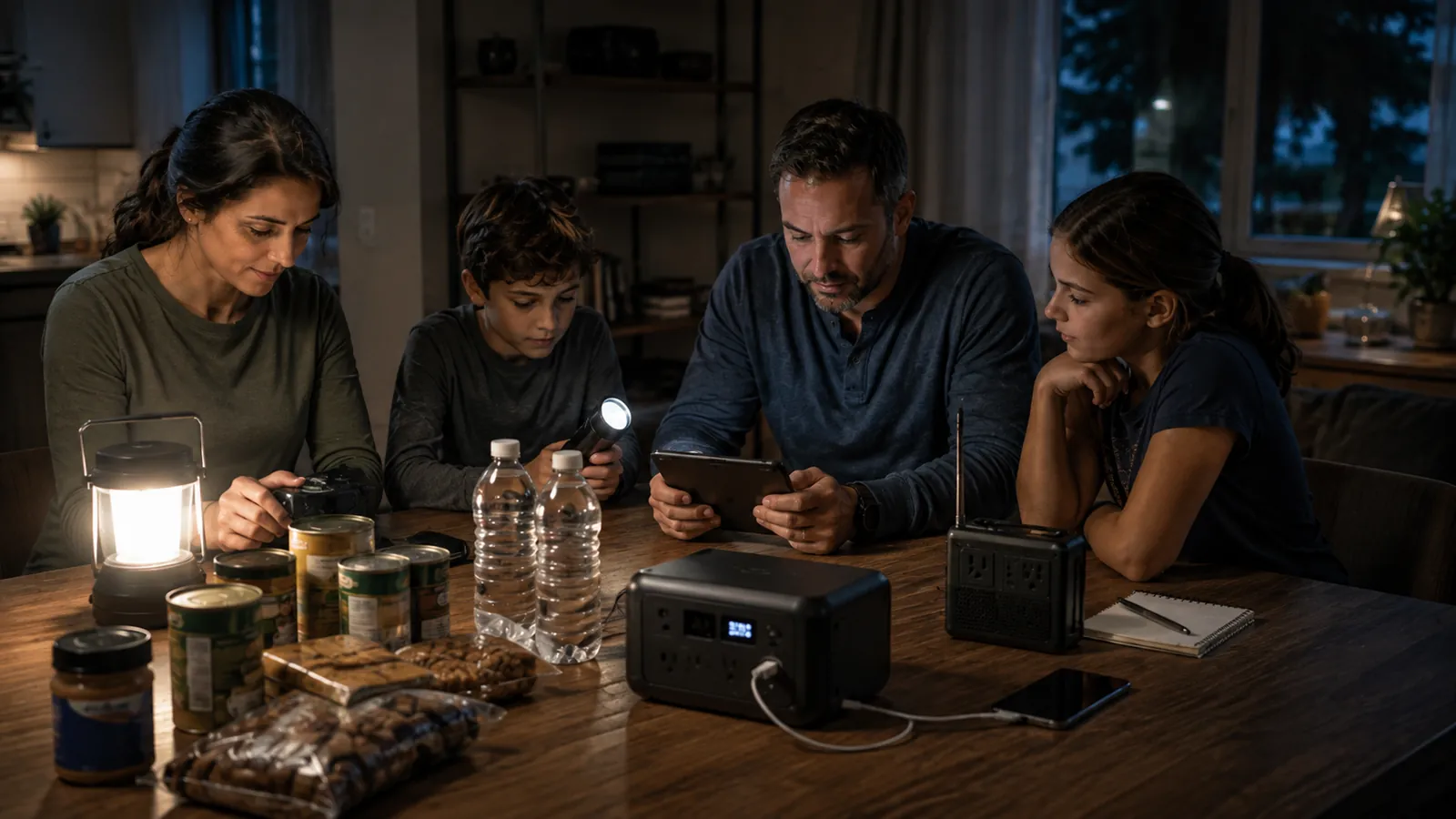
A three-day power outage is long enough to disrupt food safety, phone charging, lighting, home internet, medical routines and sometimes water or sanitation. It is also short enough that a household can prepare effectively without trying to operate the home exactly as if the grid were still available.
Before the outage: identify what actually needs power
Make a short list of devices that would matter during 72 hours. Separate them into categories: communication, medical needs, refrigeration, lighting and comfort. Phones and a few lights require relatively little energy. A refrigerator, freezer, space heater, well pump or medical device can change the plan completely.
Do not begin by shopping for a power station. Begin with the load list. If your only essential loads are two phones and rechargeable lights, small power banks may be enough. If keeping a refrigerator cold is a priority, use the Power Runtime Calculator after checking the appliance’s actual or estimated load.
First four hours: protect food and information
Keep refrigerator and freezer doors closed. CDC guidance states that an unopened refrigerator keeps food safe for about four hours. A full freezer can keep food safe for about 48 hours, while a half-full freezer is closer to 24 hours if the door stays closed. These are planning limits, not an invitation to repeatedly open the door and check.
Use phones selectively, enable low-power modes and keep at least one device available for official alerts. If local conditions could become dangerous, prioritize information over entertainment.
Lighting: use low-power, low-risk options
Working flashlights, headlamps and battery or rechargeable lanterns are efficient loads. Keep them in known locations and test them before storm season. CDC guidance recommends flashlights or battery-powered lighting rather than candles when possible because open flames add fire risk.
Communication: do not rely on one channel
Wireless Emergency Alerts can deliver urgent messages to compatible phones, but cell networks and phone batteries can fail. A battery-powered or hand-crank radio, and especially a NOAA Weather Radio where reception is available, can provide another path to official warnings. See Emergency Alerts During an Outage for the differences.
Water may also depend on electricity
Municipal water may continue during many outages, but not every household is equally resilient. Private wells often rely on electric pumps, and some water or wastewater systems can be affected by a wider infrastructure failure. Store a baseline before the outage rather than assuming the faucet will always work. Use the Water Calculator if you do not have a target.
Medical needs should drive the power plan
Powered medical equipment requires individualized planning. Identify the device’s power requirements, internal battery runtime, charging options and the provider/manufacturer guidance for outages. Do not rely on a generic household calculator for life-sustaining equipment. Keep medication and medical contact information accessible.
Refrigerator and freezer strategy
Before an expected outage, freeze water containers or gel packs if you have time and space, and consider using an appliance thermometer. Once the outage begins, keep doors closed. If refrigeration has been without power for four hours and you have ice and a cooler, CDC advises moving perishable refrigerated foods to a cooler maintained at 40°F or below.
Never taste food to decide whether it is safe. The guide Power Outage Food Safety explains the timing and decision points in more detail.
Backup power: right-size the solution
Portable power stations are convenient because they can run indoors without combustion, but capacity is limited. Generators can provide much more energy but introduce fuel, noise and serious carbon-monoxide hazards. CDC states that portable generators must be operated outdoors and at least 20 feet from doors, windows and vents. Never operate a fuel-burning generator in a home, garage or enclosed area.
For a battery power station, estimate the watt-hours required rather than comparing only marketing capacity. Allow for conversion losses, startup surges and the appliance duty cycle. A refrigerator does not draw its rated power continuously, but compressor startup can be much higher than normal running consumption.
Cooking without normal kitchen power
Build your food plan around items that can be eaten without cooking or prepared with a safe method you understand. Never use charcoal grills, camp stoves or other combustion devices indoors or in enclosed spaces. If your alternative cooking method burns fuel, follow its manufacturer’s outdoor-use and ventilation instructions.
Sanitation during a longer outage
Most power outages do not automatically disable sewer service, but private wells, pumps, septic systems and wider infrastructure failures can create sanitation problems. Keep hygiene supplies and waste bags available, and know what you would do if toilets could not be used normally. See Emergency Sanitation Basics.
A 72-hour outage checklist
- Working flashlights/headlamps and spare power.
- Phone charging and at least one backup alert method.
- Stored drinking water appropriate to the household.
- Shelf-stable food and a manual can opener if needed.
- A plan for refrigerator/freezer food safety.
- Medication and medical-device continuity.
- Hygiene and sanitation supplies.
- Safe heating/cooling plan appropriate to season.
- Backup power sized to essential loads only.
Turning off unnecessary loads, using efficient LED lighting and protecting refrigerator cold by keeping doors closed can extend a backup system far more cheaply than simply buying a larger battery.
Temperature management can become the main problem
In summer, loss of air conditioning can create health risks, especially for older adults, infants and people with certain medical conditions. In winter, a home can become dangerously cold. A backup battery large enough to run heating or whole-home cooling may be impractical, so the plan should include a safe location you can move to if indoor temperatures become unsafe.
Cash, fuel and transportation
Electronic payment systems and fuel pumps may be affected during a widespread outage. Keep a modest amount of emergency cash appropriate to your household and do not let vehicles routinely sit nearly empty when severe weather is expected. Electric-vehicle owners should consider the same principle: charging before a forecast disruption creates more options.
Home safety checks before power returns
Unplug or switch off nonessential appliances and sensitive electronics if local guidance recommends it, particularly when power is unstable. Leave one light on so you know when electricity returns. If the outage is associated with flooding, fire or structural damage, do not re-energize damaged equipment until it has been evaluated appropriately.
Your 72-hour decision timeline
Use this as an action sequence, not a rigid schedule. If a person relies on life-sustaining powered equipment, extreme temperatures threaten safety, or officials advise evacuation, act on that risk immediately rather than waiting for a timeline checkpoint.
| When | Do first | Decision trigger |
|---|---|---|
| Before an outage | Charge devices, list essential loads, identify alert sources and food-temperature supplies | Move the plan to a safer location if weather or medical needs require it |
| 0–4 hours | Keep refrigerator and freezer doors closed; use flashlights; check utility alerts | If refrigeration cannot be restored, prepare a food-safety decision |
| 4–24 hours | Reassess perishable food, water availability, communication and heating/cooling | Discard unsafe food based on temperature and time, not smell or taste |
| Day 2 | Conserve batteries and water; check household members and neighbors as safe | Reassess shelter needs if indoor conditions become unsafe |
| Day 3 and recovery | Prioritize remaining essentials; inspect for damage and restore appliances cautiously | Follow utility and local public-safety instructions before restoring systems |
Food safety baseline: an unopened refrigerator generally keeps food safe about four hours; a full unopened freezer about 48 hours (24 hours if half-full). Actual temperatures, loading, door openings and conditions matter. Use a food thermometer and FoodSafety.gov outage guidance rather than relying on these time estimates alone.
Generator rule: never operate a fuel-burning generator indoors, in garages or near air openings. Keep it outdoors and more than 20 feet from doors, windows and vents, following CDC guidance and the manufacturer’s additional requirements. Review our generator safety guide before considering one.
Related planning decisions: How to Start Emergency Preparedness at Home Without Buying Everything at Once, How Many Flashlights Do You Need for a Power Outage, Can You Charge a Power Station With Solar During an Outage and Winter Storm Preparedness Guide: Heat, Power, Water and Home Safety.
Sources & references
PrepMorrow prioritizes authoritative U.S. guidance for safety-critical preparedness information. Sources were reviewed for this guide before publication.