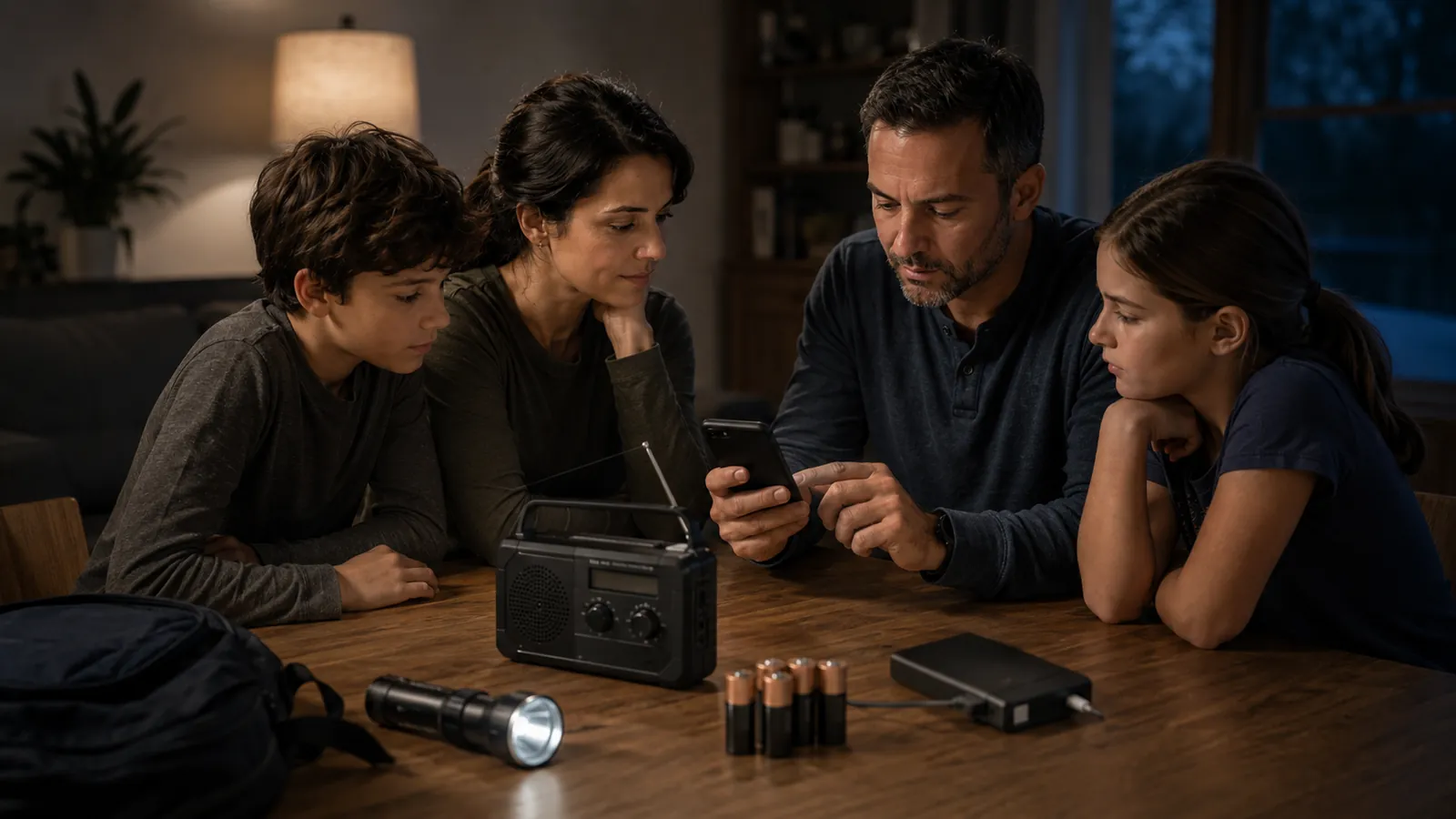
One flashlight can be enough to find the breaker panel, but it is a weak household blackout plan. People move to different rooms, someone may need both hands free, batteries fail, and the first light can easily be in the wrong place when power goes out. Ready.gov preparedness guidance recommends at least one flashlight with extra batteries per household member, which is a useful minimum starting point. A practical home plan usually adds fixed or hands-free lighting for shared areas as well.
Use people as the baseline
Start with one dependable flashlight per household member who can use one. This prevents a situation where one person has to escort everyone else through a dark home. For young children or people who need assistance, assign the light to the caregiver rather than treating the count as a rigid rule.
Keep the lights in known, reachable places rather than one emergency tote buried in a closet. A blackout often begins without warning, so the first few seconds matter.
Add shared-area lighting
Handheld flashlights are good for moving around, but they are awkward for cooking, first aid, changing a child or organizing supplies. A battery lantern or other stable area light can illuminate a table or room while keeping hands free. Headlamps are useful for tasks and stairs because the beam follows the wearer.
A simple household setup might include one personal flashlight per person plus one or two area lights for common spaces. Larger homes, multiple floors or detached buildings may justify more. The goal is coverage and redundancy, not an arbitrary gadget count.
Prioritize the places where falls matter
Stairs, hallways, bathrooms and entry routes deserve attention because darkness increases trip and fall risk. Small automatic outage lights or nightlights with battery backup can help orient people before they reach a flashlight. Keep pathways clear and avoid running cords across routes people use in the dark.
Households with mobility, vision or balance limitations should test the route from bedrooms to bathrooms and exits with the normal lights off. That practical walkthrough often reveals a better placement plan than simply buying brighter flashlights.
Flashlights are safer than candles
Ready.gov and the American Red Cross advise using flashlights rather than candles during power outages because open flames create a fire hazard. If you already keep candles for non-emergency use, do not make them your primary blackout lighting strategy.
Battery LED lighting is efficient enough that modest stored energy can provide many hours of useful light. This makes lighting one of the easier outage needs to cover with spare batteries, rechargeable cells or a small power bank.
Plan the battery system too
A drawer full of flashlights is not useful if the batteries are dead, corroded or missing. Standardizing battery sizes where practical simplifies storage. Rechargeable lights can be convenient, but keep a way to recharge them and consider at least one light that is not dependent on the same charging method.
Check lights periodically, especially before seasonal hazards. Replace damaged batteries, verify that rechargeable units hold charge and keep spare batteries in a dry, temperature-appropriate location according to the manufacturer instructions.
Brightness is not the only specification
A very bright light can drain its battery quickly and create glare indoors. Multiple brightness settings are useful because low mode may be enough for a hallway or room and can extend runtime. Beam shape matters too: a focused beam is useful for inspection and distance, while a lantern-style diffuse light is better for shared spaces.
For preparedness, reliability, runtime, battery availability and easy controls can matter more than maximum lumen output.
Build redundancy across different failure modes
If every light uses the same rechargeable battery bank and that bank is empty, the household has a single point of failure. Mix at least two practical energy paths: for example, replaceable-battery flashlights plus rechargeable lanterns, or headlamps plus a plug-in blackout light with internal backup.
Also keep one light with your go-kit or vehicle kit rather than moving every flashlight around the house. The lighting plan should still work if you need to evacuate.
A simple room-by-room plan
Bedrooms: personal flashlight or headlamp within reach. Main living area: one lantern or area light. Kitchen: hands-free or area light away from heat and water. Stairs/hallways: orientation lighting or a nearby flashlight. Entry/go-kit: portable light ready to leave with you. Then add spares based on household size and layout.
This approach gives each light a job, which is more useful than buying a large number of identical devices with no placement plan.
What about children and guests?
Do not hand a powerful flashlight to a young child and assume the problem is solved. Choose age-appropriate lighting and make sure an adult knows where it is. If guests, older relatives or caregivers regularly stay in the home, keep a spare personal light available so the blackout plan does not depend on the normal household count.
Labeling or assigning lights can reduce confusion. In a larger household, a simple rule such as “bedroom light stays beside the bed” helps prevent every flashlight from migrating to one drawer.
Apartment and multi-story homes need different placement
In an apartment, the route to a stairwell or building exit may be more important than lighting a garage or yard. In a multi-story house, each floor should have immediately accessible lighting so nobody has to use dark stairs to reach the only flashlight. Detached garages, basements and utility areas may need their own light if they are part of the outage plan.
Think through where you would check a breaker, shut off water, retrieve a go-kit or assist another person. Put lighting before the hazard point rather than beyond it.
Rechargeable vs replaceable-battery lights
Rechargeable lights are convenient and avoid keeping large quantities of disposable batteries, but they need a charging routine. Replaceable-battery lights can be easy to restore quickly if compatible batteries are in stock. Neither approach is automatically superior for every household.
A mixed system is often resilient because one charging failure does not disable every light. If you use rechargeable cells, store and charge them according to manufacturer guidance and retire damaged batteries.
How much runtime is enough?
You do not need every light running at full brightness all night. Area lighting can be used only where people are active, and personal lights can stay off when everyone is settled. Lower brightness modes can extend battery life dramatically on many LED lights.
Estimate how many hours per evening you realistically need each type of light and test one unit. Real measured runtime at the brightness setting you use is more valuable than a best-case claim from packaging.
Include lighting in the energy budget
Lighting is usually a modest load compared with refrigeration or heating, but several bright rechargeable lanterns running all evening can still consume meaningful energy from a small power station. If you plan to recharge lights from the same battery that supports a refrigerator, router or medical device, include them in the daily Wh estimate.
For many households, a combination of efficient personal lights and one low-power area light provides better coverage per watt-hour than trying to illuminate the home as if grid power were available. The objective is safe movement and essential tasks, not normal-room brightness everywhere.
Explore the full topic
Continue through the Power Outage Preparedness hub for related planning tools, guides and decision paths.
Plan by people and fixed locations
Assign each person a reliable portable light and place separate accessible lights near exits, the main sleeping area and household supplies as needed. Check replacement batteries or charging options, and practice finding lights in the dark. Headlamps can help with hands-free tasks; never use candles where a safer light is available.
Assign light to people and tasks, not just rooms
A household usually needs a dependable path to exits plus portable lights for people moving between rooms. Use the household emergency lighting guide to map tasks and power sources, then test the arrangements within the three-day outage plan. Include spare batteries or an independently charged option.
Sources & references
PrepMorrow prioritizes authoritative U.S. guidance for safety-critical preparedness information. Sources were reviewed for this guide before publication.