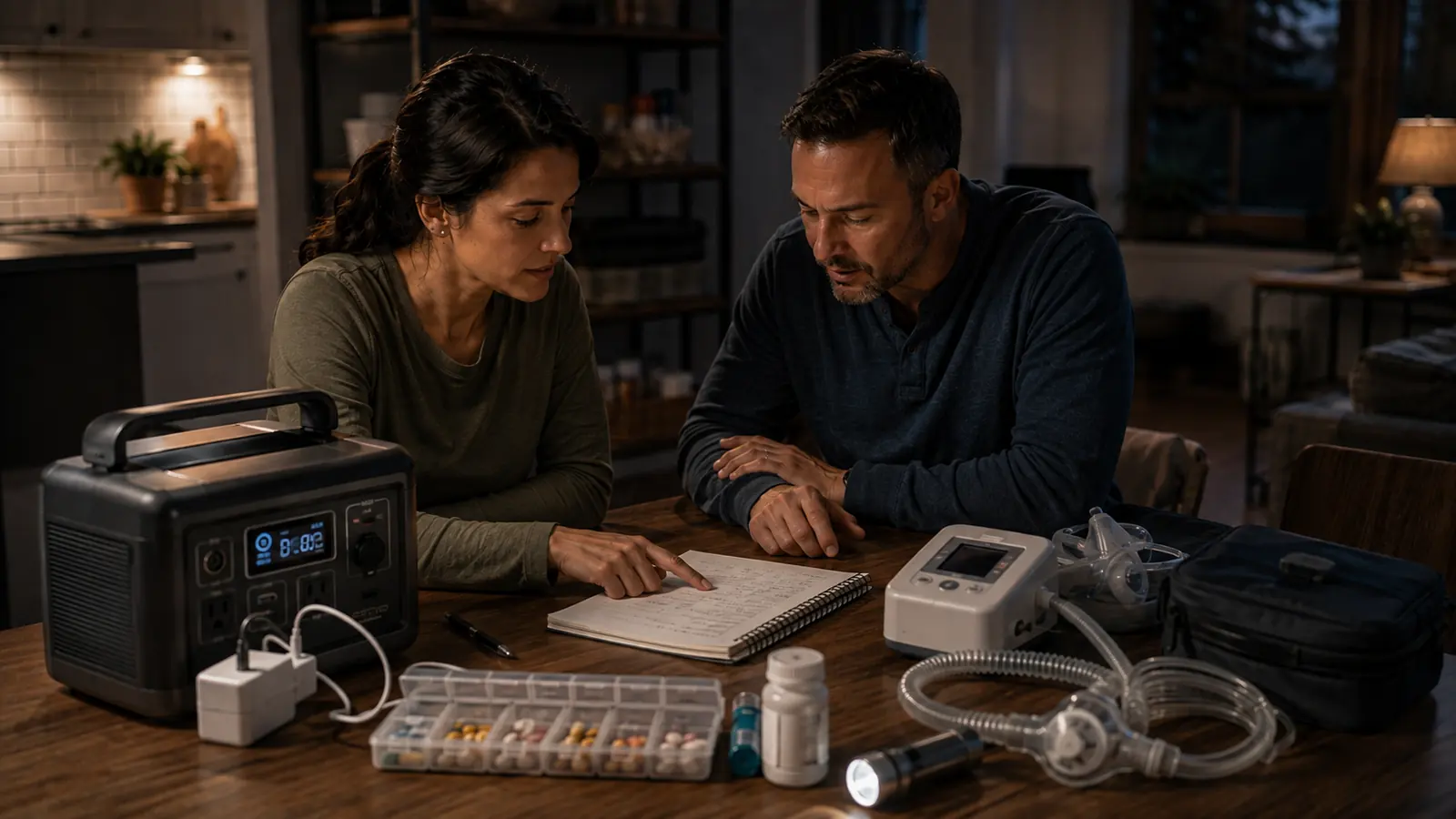
Yes, many portable power stations can be recharged from solar panels during a grid outage, but “supports solar” is not the same as “will refill every day.” The useful question is whether your particular station, panel setup, weather and available sun can replace enough energy to cover the loads you intend to run. Solar works best as an energy-budget problem, not a marketing-wattage problem.
Check whether the station actually supports your panel
Portable stations have specific solar-input voltage, current and power limits. Panels and cable arrangements must stay within those limits and use compatible connectors. Do not assume that any panel can be plugged into any station simply because both are marketed for solar use. Follow the station and panel documentation for allowable configurations.
Input limits also cap recharge speed. Connecting 600W of nominal panel capacity to a station that accepts only 300W of solar input does not make it charge at 600W. The station may limit the input, and an electrically incompatible configuration can create a safety or equipment risk.
Panel watts are not watt-hours per day
A 200W panel is rated under test conditions. In the real world, output changes with sun angle, cloud cover, temperature, shading and panel orientation. Energy harvested over a day is measured in Wh or kWh, not simply the panel’s watt rating. A panel producing an average of 120W for five useful hours would deliver about 600Wh before conversion losses; that is only an example, not a guaranteed daily yield.
This distinction matters because outage loads are also energy-per-day numbers. If the household uses 900Wh each day but the solar setup replaces only 500Wh, the battery will still decline by about 400Wh per day even though it is being charged.
Start with daily essential loads
List the loads you intend to power and estimate their Wh/day. Refrigerators should be modeled from daily energy use, not running watts times 24. Lights, phones and routers can usually be estimated from watts and hours of use. Medical devices require device-specific data and a separate contingency plan.
Once you know daily consumption, compare it with a conservative solar-harvest estimate. The aim is not necessarily to achieve 100% solar independence. Even partial recharge can extend runtime substantially, but the plan should show the deficit rather than pretending the battery resets to full every afternoon.
Weather and season can dominate the result
A setup that performs well on a clear summer day may deliver far less energy in winter, during smoke, heavy cloud or a storm system that caused the outage. Shorter daylight hours and a low sun angle reduce opportunity. If the hazard you are preparing for commonly brings poor weather, do not size the plan using ideal conditions.
Solar panels also need an area with useful exposure. Apartment dwellers, shaded lots and households that cannot safely place panels outside may have limited options. Consider that limitation before buying a large panel array that cannot be deployed where you live.
Solar does not replace safety planning
Portable battery systems avoid combustion exhaust at the point of use, which is one reason they can be convenient indoors when used according to manufacturer instructions. But solar panels, extension cables and stations still have electrical and environmental limits. Keep equipment dry as required, protect cables from trip and damage hazards, and do not place a battery where heat, water or blocked ventilation violates the product instructions.
If a gas generator is part of the backup recharge strategy, generator carbon-monoxide rules remain fully applicable. Solar charging does not make unsafe generator placement acceptable.
How long should recharge take?
A rough best-case calculation divides energy needed by effective charging watts. Replacing 1,000Wh at a steady 250W would take about four hours before allowing for charging losses and variable solar output. Real outdoor charging is rarely that steady. Use the calculation as a floor, then add margin for changing conditions.
Also check whether the station can accept solar while powering loads. Some systems support pass-through operation with limitations; others behave differently depending on ports or battery state. Follow the manufacturer documentation rather than assuming simultaneous charging and discharging works the way you expect.
When solar is most useful
Solar is especially useful when the outage may last several days and your daily loads are modest enough that partial or full replenishment is plausible. It can also reduce how often you need a vehicle or generator for charging. For very large heating, cooling or cooking loads, a portable solar setup may not replace energy nearly as fast as the household consumes it.
The best system is therefore not the one with the biggest panel number. It is the one where battery capacity, daily load and realistic recharge production fit together for the scenario you are actually preparing for.
Do not size solar from the battery alone
A common mistake is to pair a 2,000Wh battery with enough panels to theoretically refill 2,000Wh every day even though the household only consumes 600Wh per day. Another mistake is the opposite: a large daily load with a token panel that barely offsets standby consumption. Size the recharge side from the expected daily energy deficit.
If the battery begins the outage full, it can temporarily cover a deficit. Over several days, however, the balance between daily consumption and daily harvest becomes more important than the starting capacity. This is the same logic used in any energy-storage system: storage smooths the mismatch, but generation determines long-duration sustainability.
Panel placement can be the limiting factor
Portable panels need safe, practical exposure to sunlight. Shading from one tree, balcony railing or neighboring building can reduce output, and partial shading can affect some panel configurations more than others. Think about where the panels will physically sit, how cables reach the station and whether they can be secured against wind without creating a trip hazard.
Do not plan to place indoor-rated electronics outside simply because the panels are outdoors. Keep the station itself within the environmental limits stated by the manufacturer.
What about charging while it is cloudy?
Solar panels can still produce energy under some cloudy conditions, but output may be far below the rating. The relevant question is not whether the charging icon appears; it is how many watt-hours the system actually adds over the day. A station that gains 100Wh while the household consumes 700Wh is still moving toward empty.
For storm-prone outages, use a conservative scenario and consider a second recharge path. Redundancy could mean AC charging at another powered location, approved vehicle charging, or another safe source appropriate to your equipment.
Test the full cable chain before you need it
Adapters, extension leads and connectors are easy to overlook. Assemble the exact panel-to-station configuration in advance, verify that the station recognizes the input, and learn where its solar input limits are documented. Keep required adapters with the panels rather than using them for unrelated projects and losing track of them.
A short practice session also shows whether the panel location, cable length and station placement are realistic at your home. A solar plan that exists only on a product page is not yet an outage plan.
Explore the full topic
Continue through the Power Outage Preparedness hub for related planning tools, guides and decision paths.
Estimate solar as variable replenishment
Check panel voltage/current compatibility and the station’s solar input limits first. Then compare expected daylight and shading with daily energy use. Panel nameplate watts are achieved only under favorable conditions; cloudy weather, angle, heat and charging losses can reduce harvest substantially. Maintain a plan for days when solar replenishment is negligible.
Plan for variable solar output
The panel’s rated watts are not a guaranteed hourly yield: shade, orientation, clouds, temperature and charge-controller limits matter. Estimate the daily essential load using the runtime calculator, size the storage and inverter with the size finder, and use the backup-power buying guide for system trade-offs. Always check the manufacturer’s solar input specifications.
Sources & references
PrepMorrow prioritizes authoritative U.S. guidance for safety-critical preparedness information. Sources were reviewed for this guide before publication.