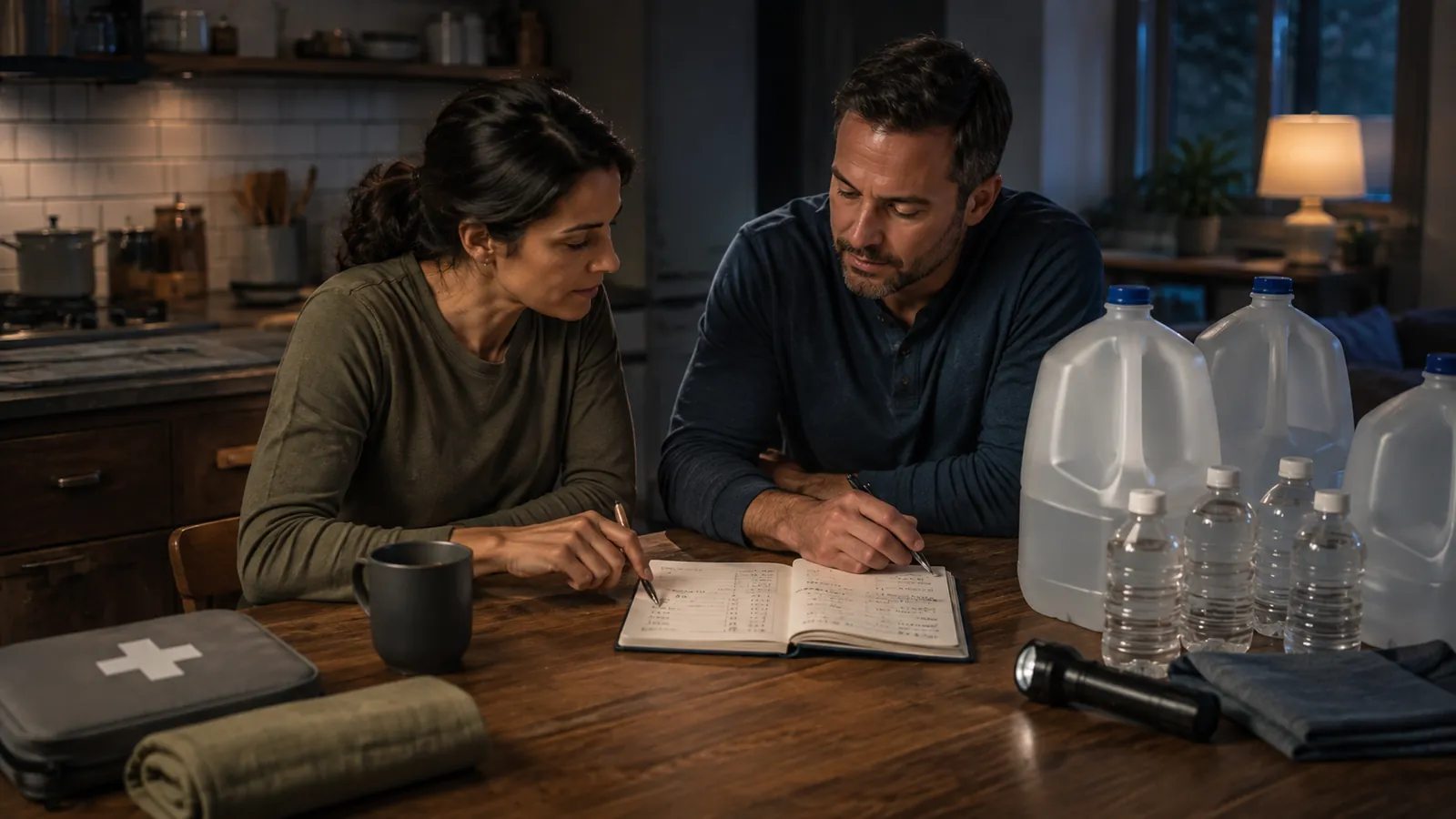
Quick answer: Use at least one gallon per person per day as the basic U.S. planning benchmark. CDC recommends a minimum three-day supply and says to try to store a two-week supply if possible. A family of four therefore starts at 12 gallons for three days and reaches 56 gallons for two weeks before adding pets or higher needs.
The simple calculation
Multiply the number of people by the number of days and by one gallon. This benchmark covers drinking plus basic uses such as cooking and brushing teeth; it is not meant to reproduce normal household water consumption.
Example household amounts
- 1 person: 3 gallons for 3 days; 14 gallons for 2 weeks
- 2 people: 6 gallons for 3 days; 28 gallons for 2 weeks
- 4 people: 12 gallons for 3 days; 56 gallons for 2 weeks
- 5 people: 15 gallons for 3 days; 70 gallons for 2 weeks
When you should store more
CDC specifically advises considering more water for pregnant people, people who are sick, pets and hot climates. Heavy physical activity and household-specific medical needs can also increase demand.
Do not treat one gallon as a hard maximum. It is a baseline for planning when normal service is unavailable.
Why three days and two weeks both matter
A three-day reserve is a manageable first milestone and fits many evacuation or short-disruption scenarios. A two-week home supply provides more resilience when roads, utilities or deliveries remain disrupted. The Red Cross similarly distinguishes a three-day evacuation supply from a two-week home supply.
The useful approach is progressive: reach three days first, then add water in manageable increments until space, budget and household risk support a longer reserve.
Stored water comes before treatment
A filter, purification bottle or tablets can extend resilience, but treatment requires a source of water. A disruption may leave you with no convenient source to collect. Immediately available stored water is therefore the first layer; treatment is redundancy.
Choose containers that match the math
Water is heavy—roughly 8.3 pounds per U.S. gallon. A 5-gallon container weighs more than 40 pounds when full. Large tanks use space efficiently but may be impossible for some household members to move.
CDC recommends unopened commercially bottled water as the safest and most reliable emergency source. For home-filled storage, use food-grade containers that close tightly and were never used for toxic chemicals.
How long should home-filled water sit?
Current CDC guidance says water you fill yourself should be replaced every six months. Label containers as drinking water and add the storage date. Commercial bottled water should be handled according to its expiration or manufacturer information.
Where to store it
CDC recommends a cool location away from direct sunlight and toxic substances. Spread heavy containers across appropriate shelving or floor locations rather than placing excessive load on weak shelves. Keep at least a small amount easy to access without moving the entire reserve.
Do pets count?
Yes. Add drinking water for pets to the household calculation instead of assuming the human allotment will cover them. The amount varies by animal, diet and temperature, so use your normal daily consumption as a starting point and ask a veterinarian when special conditions apply.
What if you do not have room for two weeks?
Do not let the ideal target stop you from storing anything. Reach three days first, then add one or two days at a time. In an apartment, distribute containers across safe low storage areas and combine sealed bottles with larger jugs.
A maintained seven-day reserve is materially better than a theoretical two-week plan that never gets implemented.
Water for cooking versus drinking
The one-gallon benchmark includes more than drinking. If your emergency food requires lots of boiling water, your real demand rises. A pantry with ready-to-eat foods reduces both water and fuel requirements.
Track water as a household resource shared by drinking, food preparation and basic hygiene rather than treating every gallon as beverage water.
What about the water heater or bathtub?
Water already in household plumbing may sometimes be usable, but access and safety depend on the emergency and local guidance. Do not count uncertain sources as your primary reserve. Bathtub liners and other opportunistic storage can add capacity before a forecast event, but they do not replace a maintained drinking-water supply.
If authorities issue a contamination advisory, follow their instructions before using any household source.
A realistic staged target
Stage 1: three days. Stage 2: one week. Stage 3: two weeks where practical. At each stage, verify container condition, storage location and the ability of household members to dispense the water.
The goal is not the largest number of gallons—it is safe water that can actually be used.
Frequently asked questions
Is one gallon per person per day only for drinking?
No. The CDC benchmark is intended to cover drinking and basic uses such as cooking and brushing teeth. Households with higher hygiene, medical or climate-related needs may need more.
Can I store less water if I own a filter?
A filter is backup treatment, not guaranteed supply. You may have no accessible source to filter, or the source may contain contaminants outside the filter’s capability. Keep immediately available stored water first.
Does commercially bottled water need six-month replacement?
The six-month replacement guidance applies to water you fill into your own storage containers. For unopened commercially bottled water, follow the product’s expiration or manufacturer guidance and store it appropriately.
Bottom line
Good preparedness is not about maximizing gear. Use authoritative guidance as the baseline, adapt it to your household and local hazards, and maintain the supplies often enough that they are ready when needed.
A practical container plan for four people
The minimum planning math is straightforward: four people × one gallon × three days = 12 gallons. For a two-week target, four × one × fourteen = 56 gallons. These are baseline amounts for drinking and basic needs, not a guarantee that every household will have enough.
| Stage | Water | One workable container mix | Approximate water weight |
|---|---|---|---|
| First 72 hours | 12 gallons | Two 5-gallon containers and two 1-gallon containers | 100 lb |
| Two weeks | 56 gallons | Ten 5-gallon containers and six 1-gallon containers | 467 lb |
Water alone weighs about 8.34 pounds per U.S. gallon; add the weight of bottles and containers. A full 5-gallon container holds roughly 42 pounds of water. Avoid placing heavy containers on weak shelves. Divide the supply among accessible, cool storage areas that can bear the load, and check what you can actually lift.
A safer staged approach: buy or fill the first 12 gallons, confirm where the containers will sit, then add more in manageable increments. Keep pet water, infant-formula requirements and medically necessary water needs as separate line items. Do not assume a filter replaces a stored reserve, especially when the source water may be chemically contaminated.
For household-specific quantities, use the Water Storage Calculator and confirm current storage recommendations with CDC emergency water guidance.
Sources & references
- CDC: How to Create an Emergency Water Supply — baseline storage quantities, handling and household needs.