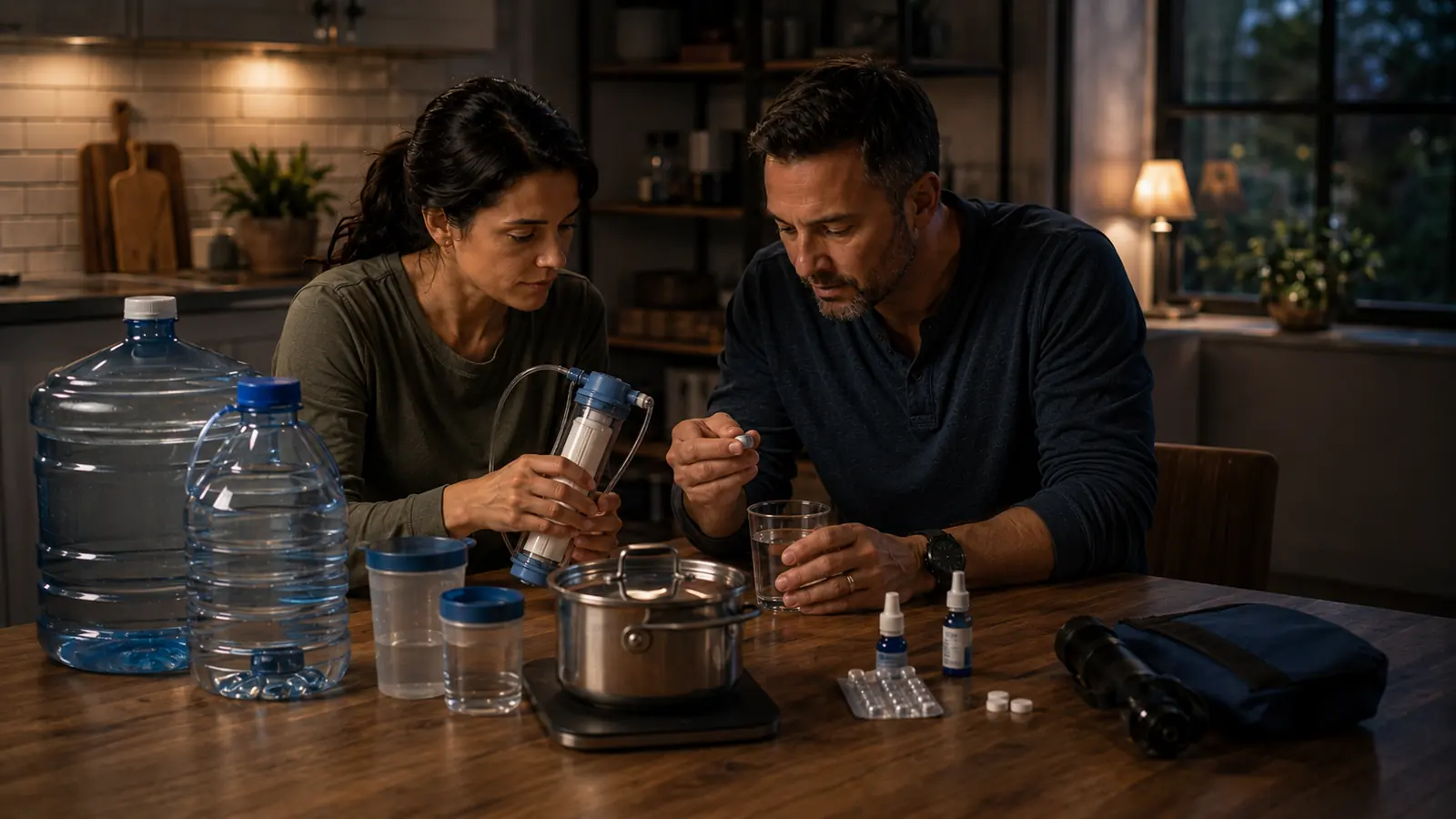
Emergency water treatment is often oversimplified into a single product recommendation. In reality, boiling, chemical disinfection and filtration solve different problems. The correct method depends on what may be in the water and what official authorities are telling you about the water system.
CDC states that boiling is the best way to kill germs in water when bottled water is not available. It also warns that water contaminated with fuel, toxic chemicals or radioactive materials cannot be made safe by boiling, disinfecting or filtering. In those situations, the solution is a different water source, not a stronger filter.
Start with the advisory, not the treatment method
Before treating tap water after an emergency, check instructions from your water utility, health department or emergency management agency. A boil-water advisory is different from a ‘do not drink’ or ‘do not use’ advisory. If officials say the water contains or may contain harmful chemicals, follow their directions and use an alternative source.
Treatment advice also changes when floodwater may have entered a private well. Well owners may need disinfection, flushing and laboratory testing before normal use resumes.
Boiling: the preferred general method for germs
CDC guidance says to bring clear water to a rolling boil for one minute. At elevations above 6,500 feet, boil for three minutes. If water is cloudy, first let sediment settle or filter it through a clean cloth, paper towel or coffee filter, then boil the clearer water. Allow boiled water to cool and store it in clean, sanitized, covered containers.
Boiling is effective against bacteria, viruses and parasites. It does not remove salts, heavy metals, fuels or most toxic chemicals. In some chemical-contamination scenarios, heating can make exposure worse by concentrating nonvolatile contaminants as water evaporates.
Chemical disinfection: useful when boiling is not possible
EPA and CDC provide emergency disinfection instructions using unscented household chlorine bleach of an appropriate concentration. The exact dose depends on bleach concentration and whether water is clear or cloudy, so follow current official instructions rather than memorizing a number from an old article or label.
Chemical disinfection is mainly a method for killing many disease-causing microorganisms. It is not a general-purpose chemical purifier and will not make fuel- or toxin-contaminated water safe.
Filtration: understand the organism claim
Portable filters vary widely. Some are designed primarily to remove parasites and sediment. Others may be rated for bacteria, and specialized purification systems may address viruses. CDC notes that most portable water filters do not remove bacteria or viruses, which is why filtration may need to be followed by disinfection.
Read the product’s actual performance claims and certification information. Terms such as ‘0.1 micron’ or ‘activated carbon’ are not, by themselves, a complete answer to whether a device removes a specific pathogen or chemical. Activated carbon can improve taste and reduce some compounds, while membrane filters can remove particles and certain organisms depending on pore size and design.
Why ‘filter then disinfect’ can be useful
Cloudy water can interfere with treatment and is unpleasant to drink. Removing sediment first can make subsequent disinfection more effective and easier. CDC guidance for uncertain natural water sources often recommends filtering and then disinfecting when boiling is not available.
This two-step idea should not be confused with making chemically contaminated floodwater safe. If the water source may contain fuel, pesticides, industrial chemicals or radioactive contamination, use a different source and follow public-health guidance.
Household filters do not cancel a boil-water advisory
During a boil-water advisory, CDC advises boiling tap water even if it has passed through a typical home filter or pitcher. Unless a device is specifically designed and validated for the exact hazard, the advisory remains the controlling instruction.
Store treated water safely
Treatment can be undone by recontamination. Use clean containers with tight covers, avoid dipping dirty cups or hands into stored water, and keep containers away from chemicals. Label water that has been treated during an emergency so household members know what it is and when it was prepared.
Build treatment as a backup to stored water
Stored drinking water solves the immediate problem: you can drink without first diagnosing the water source, finding fuel, waiting for a chemical contact time or relying on a filter. Treatment methods add resilience when an outage lasts longer than your stored supply or when an advisory affects normal tap water.
Use safe commercially bottled or properly stored water first when available. If officials say biological contamination is the concern and no safe water is available, boiling is the preferred general method. Use other treatment methods according to current CDC/EPA instructions and the specific hazard.
What to keep with your water plan
- A way to receive local water advisories.
- A heat source that can be used safely if boiling is part of the plan.
- Clean containers for treated water.
- A current printed copy or saved offline copy of CDC/EPA emergency treatment instructions.
- Any filter replacement parts or treatment chemicals required by your chosen backup method.
Do not confuse purification claims with emergency guidance
Consumer water products use terms such as filter, purifier, microfilter, ultrafilter and reverse osmosis. Those words describe technologies or marketing categories, not a universal emergency guarantee. The meaningful question is what the device has been tested or certified to reduce and whether that matches the hazard. A filter that is excellent for parasites on a hiking trip may be the wrong tool for a virus risk, a saltwater source or chemical contamination after an industrial spill.
For household preparedness, keep the device documentation with the filter and record the replacement interval. A clogged or expired element discovered during an outage is not a backup plan.
Consider the energy cost of boiling
Boiling is microbiologically effective, but heating several gallons of water requires fuel or electricity. A household that expects a long power outage should not assume it can boil every gallon on an electric range. If boiling is part of the backup plan, identify a safe heat source and estimate the fuel needed. Never move grills, camp stoves or other combustion appliances indoors to boil water; carbon monoxide can accumulate quickly.
Keep treatment instructions offline
Bleach concentrations and public-health instructions can change, and the correct dose depends on the product. Save or print current CDC or EPA instructions rather than relying on memory. If you store bleach for emergency disinfection, check the product label and age because chlorine strength declines over time. Never use scented, splashless or additive-containing products unless current official instructions specifically allow them.
A water-safety decision path
- Identify the notice: determine whether authorities issued a boil-water, do-not-drink or do-not-use notice. These are not interchangeable.
- Use known-safe supplies first: sealed bottled or previously stored drinking water may be the simplest immediate option when safe and available.
- Check the hazard before treatment: boiling can address many microbial hazards but will not remove fuel, chemical contamination or dissolved pollutants.
- Use the method that matches official instructions: follow local water-authority directions and current CDC/EPA treatment guidance; do not infer purification from a generic household filter label.
- Protect treated water: use clean, food-safe containers and prevent recontamination.
Escalation: If chemical contamination is suspected or an advisory forbids using the water, do not treat that water as safe merely because it was boiled or filtered. Follow the water authority and obtain a suitable alternative source.
For a closely related household decision, see Can You Drink Filtered Water During a Boil Water Advisory.
Sources & references
PrepMorrow prioritizes authoritative U.S. guidance for safety-critical preparedness information. Sources were reviewed for this guide before publication.