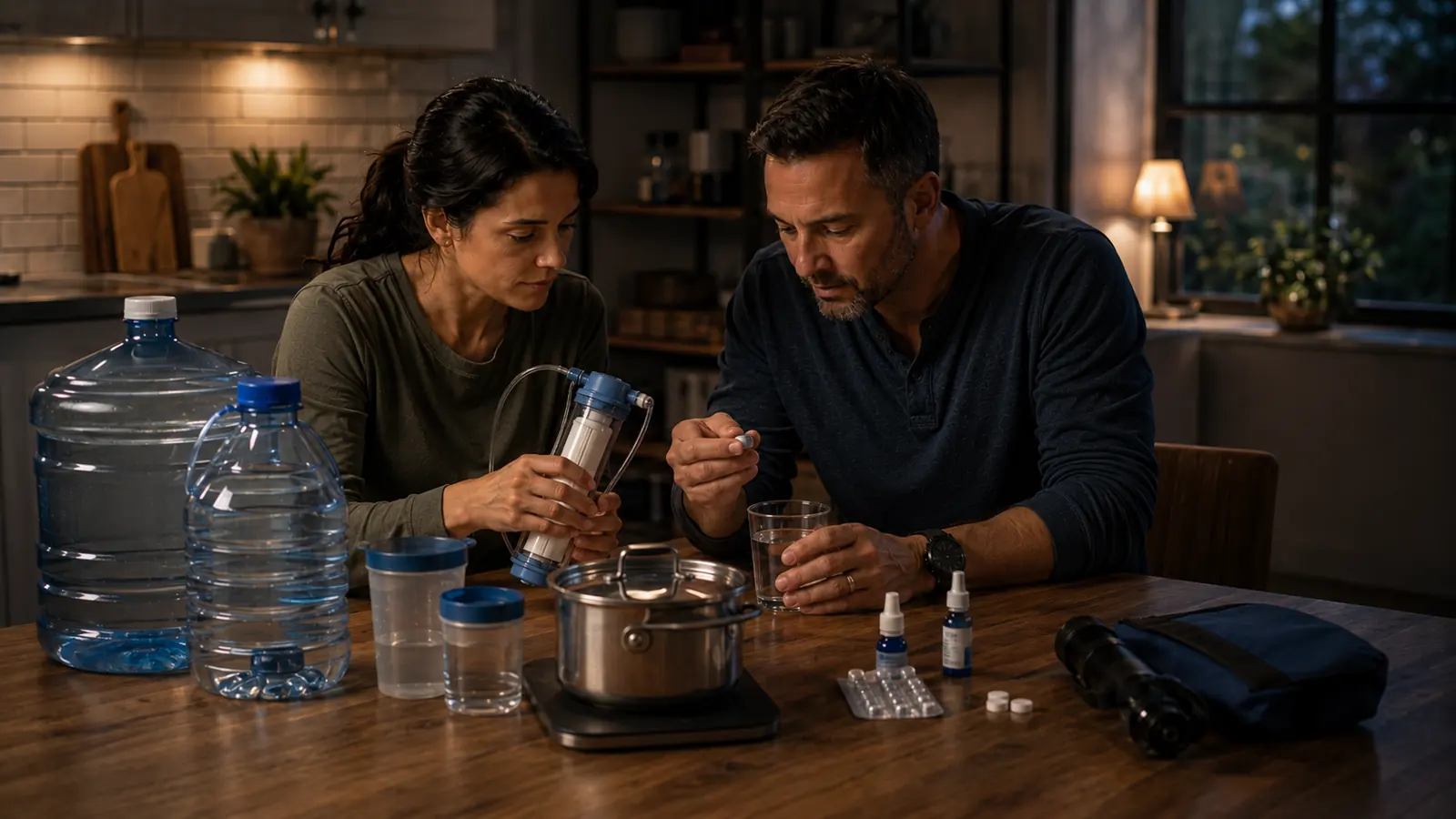
“Water filter” can mean a refrigerator cartridge, a whole-house sediment system, a reverse-osmosis unit, a backpacking filter or an emergency purifier. Those products may look related in a store category, but they are not interchangeable.
The key distinction is the source water and the hazard you need to address. Home filtration usually starts with water that is already supplied to the house. Emergency treatment may start with water of uncertain microbiological quality, and the treatment method must match that risk.
Home water filtration starts with a defined household water problem
For normal household use, identify the contaminant or quality issue first. EPA recommends choosing treatment technology and certification based on the contaminant you want to reduce. A point-of-use filter may address drinking water at one faucet; a whole-house system may address sediment or another household-wide concern.
These systems can improve everyday resilience and water quality, but most still depend on an available water supply and often on normal plumbing pressure.
Emergency water treatment starts with safety
During an emergency, water may be unavailable, under an advisory or obtained from a source that is not normally used for drinking. Boiling, disinfection and filtration have different capabilities. Some filters remove protozoa and bacteria but not viruses; some household filters are designed for chemical contaminants and not pathogens at all.
Use current CDC/EPA emergency-water guidance for the specific situation. If local authorities provide instructions, those instructions take priority over a generic product claim.
| Situation | Primary question |
|---|---|
| Normal tap water with a known contaminant concern | Which certified home treatment technology addresses that contaminant? |
| Water service still available during an outage | Does the system still have pressure/power, and is there an advisory? |
| Boil-water advisory | What exactly do local officials instruct? Do not assume normal filtration replaces boiling. |
| No running water | Use stored water first; if treating alternate water, match the method to the hazards. |
Why certifications matter
Independent certification helps verify specific contaminant-reduction claims, but a certification must be read in context. Different NSF/ANSI standards and performance claims apply to different contaminants and technologies. A label that verifies lead reduction does not automatically establish pathogen removal, and a mechanical filter marketed for outdoor use does not automatically address chemical contamination.
For home filtration purchases, verify the exact claim in the certification body’s product directory when the claim matters to your decision.
Why stored water remains the first layer
Treatment takes time and requires a usable source. Stored drinking water is immediately available when a pipe breaks, pressure disappears or local water cannot be used. CDC recommends creating and storing an emergency water supply as part of household planning.
Use the Water Calculator for a baseline and How to Store Emergency Water Safely for maintenance.
Where DiscountFilterStore-type products fit
Whole-house, under-sink and countertop products can be useful solutions for normal household filtration and water-resilience goals when their documented performance matches the need. PrepMorrow’s Home Water Filtration Buying Guide therefore treats them as an adjacent preparedness category rather than labeling them emergency purification products.
That distinction protects the decision architecture: a merchant feed can supply current options, but it does not redefine what is required to make unsafe water safe.
The word “purifier” needs scrutiny too
Manufacturers and retailers may use “filter” and “purifier” differently. For household planning, ignore the marketing category and look at the actual performance claims, test standards and intended source water. A product may reduce bacteria but not viruses, or may reduce chemical contaminants but have no validated microbiological performance. The source and hazard determine whether that matters.
Mechanical filtration, adsorption, RO, UV and disinfection are not the same process
Mechanical media physically retain particles or organisms above a certain size. Activated carbon adsorbs certain chemicals and improves taste/odor depending on design. Reverse osmosis uses a membrane and pressure to reject many dissolved contaminants. UV can inactivate susceptible microorganisms but does not remove sediment or many chemicals. Chemical disinfection targets microorganisms but does not remove many dissolved contaminants. Systems can combine these methods.
This is why “how many stages?” is a weak buying question. The relevant question is whether the complete system has verified performance for the contaminants or organisms you need to address.
Home filtration assumes a more controlled source
Municipal tap water has already been treated and monitored under drinking-water regulations. A home system usually provides additional treatment for a specific concern. Private-well water can be more variable, but treatment should still be selected from test results rather than emergency improvisation.
Emergency source water can be much less predictable. Floodwater, for example, may contain sewage, fuels, chemicals and debris. No portable consumer filter should be assumed to make heavily contaminated floodwater safe. Follow official emergency-water guidance and avoid unsafe sources when alternatives exist.
Capacity and maintenance can matter as much as initial performance
A filter may perform well when new but lose flow or treatment capacity as media is used. Emergency planning should include replacement elements, storage conditions and the volume of water a household may need. A tiny personal filter can be useful for one person but impractical for cooking, pets and a multi-person household over several days.
Pressure and power dependencies change resilience
Installed systems often require plumbing pressure. RO booster pumps and UV stages may require electricity. Gravity-fed products avoid some of those dependencies but still need a safe container, maintenance and verified treatment capability. Think of resilience as the combination of treatment performance and the infrastructure required to make the treatment work.
A three-layer household water strategy
- Stored potable water: immediate supply when plumbing is unavailable.
- Everyday home filtration: optional treatment matched to known household water-quality goals.
- Emergency treatment capability: a method appropriate to the alternate source and hazard, used according to official guidance.
A household may use all three layers, but one should not silently substitute for another.
Buying checklist for home filtration
- Identify the contaminant or water-quality problem.
- Verify the exact model’s independent certification claim.
- Understand flow rate and pressure requirements.
- Price replacement media and maintenance.
- Check electrical dependencies.
- Keep emergency stored water separately.
Emergency-treatment checklist
- Start with official guidance for the event and source water.
- Avoid sources contaminated by fuels, toxic chemicals or floodwater when possible.
- Understand which microorganisms/contaminants the treatment addresses.
- Use boiling or disinfection when recommended.
- Have enough throughput for the whole household.
Frequently asked questions
Is a camping filter an emergency filter?
It can be one component of an emergency plan if its verified treatment capabilities match the likely source-water hazards and household volume needs. Outdoor-use marketing alone is not enough. Many portable filters focus on microorganisms and do not address chemical contamination.
Is reverse osmosis an emergency purifier?
Installed RO can be very effective for specific dissolved contaminants, but it normally relies on pressurized feed water, intact plumbing and maintenance. It is therefore usually a home-treatment system, not a standalone solution for a complete water-service failure.
Can activated carbon make floodwater safe?
No general carbon-filter claim should be interpreted that way. Floodwater can contain pathogens, fuels, pesticides, sewage and other contaminants. Avoid using heavily contaminated floodwater for drinking when safer sources are available and follow official guidance.
Why does PrepMorrow show home filters in a preparedness buying guide?
Because household resilience includes everyday water quality and the ability to maintain a functioning drinking-water system, but the products are labeled as adjacent solutions. The buying guide does not let a merchant catalog redefine emergency treatment requirements.
Match the water source, hazard and device claim
| Question | Household comfort filter | Emergency treatment decision |
|---|---|---|
| What is the source? | Usually a known household supply | May be unknown or compromised; source safety is the first decision |
| What must be removed? | Specified taste, sediment or listed contaminants | Hazard-specific microbes or chemicals; a general “filter” label is inadequate |
| Will it work without utilities? | May require pressure or electricity | Must be validated for the actual outage scenario |
| What proves suitability? | Relevant independently verified contaminant claims | Verified treatment capability plus current public-health instructions |
If contamination is uncertain, prefer known-safe stored water and current instructions from the water authority. Commercial filters should never be presented as universal emergency purifiers.
Match the treatment method to the water hazard
Emergency purification and ordinary household filtering solve different problems. Compare boiling and disinfection limits in the emergency treatment guide before assuming a home-filter cartridge is sufficient for microbiological contamination.
For a closely related household decision, see Do Whole-House Water Filters Remove Bacteria.
Sources & references
PrepMorrow prioritizes authoritative U.S. guidance for safety-critical preparedness information. Sources were reviewed for this guide before publication.