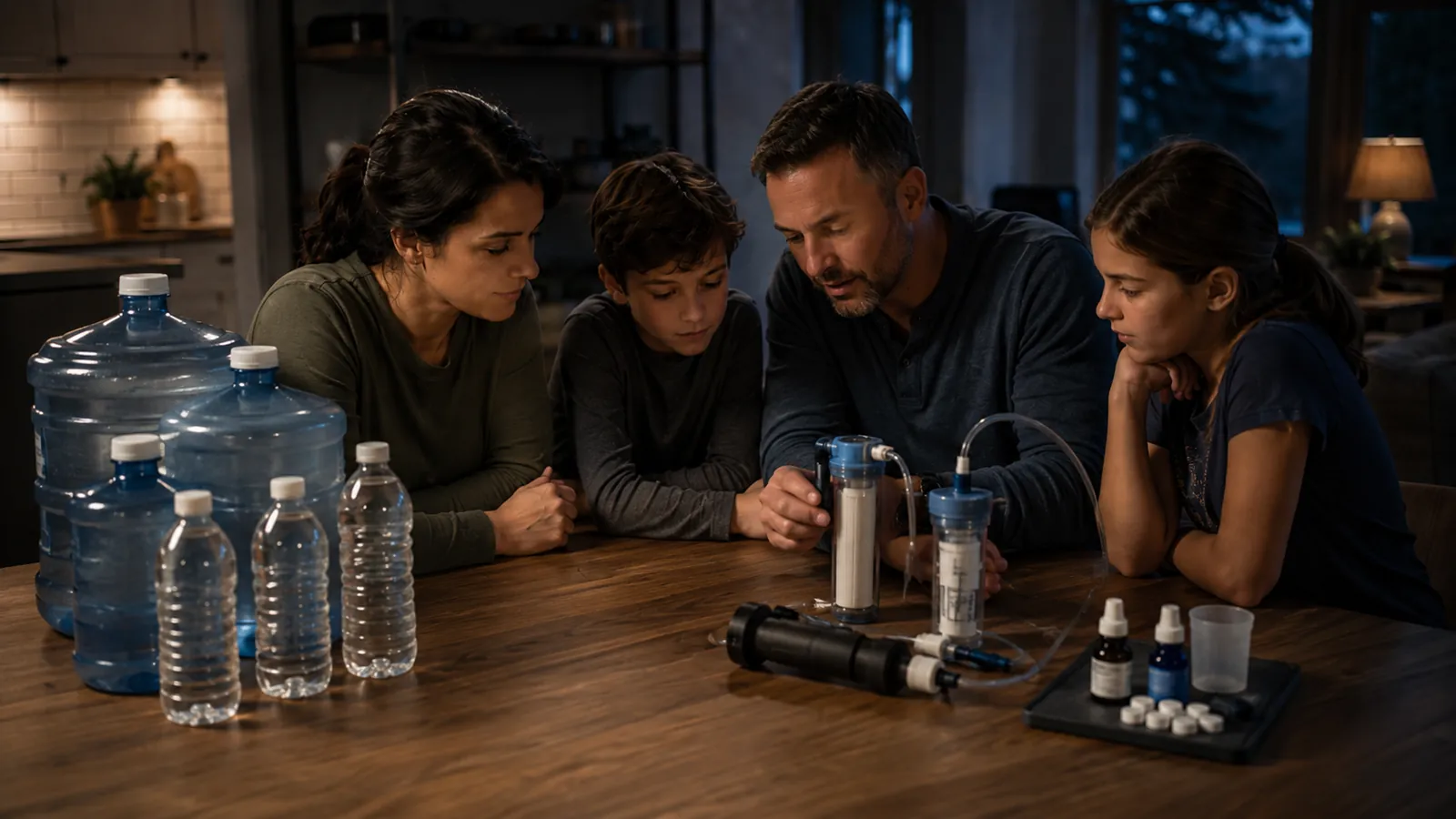
Some home water filters can continue filtering during a power outage, while others cannot. The answer depends less on the word “filter” and more on how water reaches the device and whether any part of the treatment process requires electricity.
A power outage can also remove water pressure entirely, especially in homes served by an electric well pump. That means a filter that itself uses no electricity may still have no water to process.
First question: do you still have water pressure?
Municipal systems may maintain pressure during some outages, but pressure can be reduced or service can be interrupted depending on the event. A private well generally relies on an electric pump unless a separate backup system is available. If no water reaches the filter, the filter cannot help.
Treat water service and water treatment as separate dependencies in your outage plan.
Filters that may work without household electricity
Many simple cartridge, faucet and gravity filters do not need an electrical connection for the filtration media itself. Installed cartridge systems still need water pressure. Gravity units can operate without plumbing pressure, but only within the treatment capabilities of that specific product.
Do not infer microbiological safety from the fact that a unit works without power. A home drinking-water filter designed for taste, chlorine, lead or another specific contaminant may not remove pathogens from unsafe source water.
Systems that can depend on power
Some reverse-osmosis installations use booster pumps, UV treatment requires electricity, and electronically controlled systems can have powered valves, monitors or pumps. Whole-house treatment may also be tied to an electric well pump. Check the documentation for your exact system rather than assuming the plumbing connection tells you everything.
A boil-water advisory changes the decision
If local authorities issue a boil-water advisory, follow the advisory instructions. Do not assume your normal refrigerator, under-sink or whole-house filter makes boiling unnecessary. CDC guidance notes that advisories can have different causes and instructions. Some home filters are not designed to remove microorganisms.
See What to Do During a Boil Water Advisory before using filtered tap water for drinking, food preparation, brushing teeth or other uses covered by the advisory.
Build a layered water plan
- Stored drinking water that is available even if plumbing stops.
- A normal home filtration system matched to known everyday water-quality needs.
- A separate emergency-treatment method appropriate for the source water and public-health guidance.
- A way to boil water when boiling is recommended and conditions allow it.
The layers overlap, but they should not be treated as interchangeable. This is why PrepMorrow keeps home water filtration separate from emergency water treatment.
Outage planning for a private well
If your household relies on a well, the central outage problem may be pumping rather than filtration. Determine the pump’s electrical requirements before considering backup power, and avoid improvised electrical connections. A large well pump can have startup requirements that are very different from small electronics.
Keep stored water even if you have generator or battery backup; mechanical failure, fuel limits or other problems can still interrupt pumping.
Common household setups and what an outage can change
Municipal water + simple under-sink cartridge: the filter itself may need no electricity, so it can keep working as long as the water system maintains adequate pressure and no advisory changes how the water should be used.
Private well + any pressure-fed filter: the filter may be passive, but the well pump usually needs electricity. Without pump power or stored pressure, there may be no flow through the filter.
Reverse osmosis: many systems rely mainly on water pressure, while some have booster pumps or powered monitoring. A pressurized storage tank can provide a limited amount of water after pressure is lost. Exact behavior depends on the system.
UV treatment: ultraviolet disinfection requires power. If UV is a critical treatment barrier, loss of electricity can change whether water should be considered treated even if water continues to flow.
Gravity countertop system: gravity can move water without plumbing or electricity, but the device is only as protective as its verified treatment capability and the source water it is designed to handle.
Why a filter can become a false sense of security
During a disaster, people often think “filtered” means “safe.” That is too broad. A carbon cartridge may improve taste and reduce specific chemicals while doing little or nothing for pathogens. A sediment filter may remove particles but not dissolved contaminants. A reverse-osmosis membrane may have strong contaminant-reduction capabilities but still depend on pressure, prefilters and maintenance.
Use the product’s verified claims and public-health instructions, not the category name.
Make a one-page water-system dependency map
Write down the source (municipal or well), the equipment between the source and drinking faucet, and which parts need power, pressure, consumables or periodic service. This small exercise often reveals a hidden single point of failure. For example, a household may own an expensive whole-house filter but have no stored drinking water if the well pump loses power.
Should you use backup power for a well pump or filter?
Possibly, but pump loads can be substantial and may have high startup demand. Do not connect a pump to a battery station or generator based on guesswork. Verify voltage, running load, starting requirements and connection method. Fixed home electrical systems may require transfer equipment installed according to code. If a generator is involved, avoid backfeeding and follow the safety guidance in Generator Safety During a Power Outage.
Water outage checklist
- Know whether your source is municipal or private well.
- Know whether pressure remains if grid power fails.
- Know which treatment stages require electricity.
- Keep stored drinking water independent of the filter.
- Follow boil/do-not-drink/do-not-use advisories exactly.
- Keep replacement filters and maintenance information accessible.
Commercial filtration belongs after the dependency check
If your goal is normal household filtration, the Home Water Filtration Buying Guide can help compare current whole-house, under-sink and countertop categories. The guide intentionally does not label those products emergency treatment unless their documented capabilities justify that description.
Frequently asked questions
Will a refrigerator water dispenser work in an outage?
The refrigerator itself needs electricity for normal dispenser and ice-maker operation, even if household water pressure remains available. Do not count a refrigerator dispenser as the only access point for drinking water during an outage.
Does a whole-house cartridge filter need electricity?
A basic cartridge housing may not, but it still needs water pressure. Systems that add UV, pumps, electronic valves or controls can have electrical dependencies. Check the complete system, not just the cartridge.
Can I fill containers through my filter before a storm?
If the tap water is safe and the filter is operating normally, filling clean food-grade containers in advance can be part of your storage plan. Follow CDC storage guidance and do not wait until an advisory has already been issued to decide how to create the reserve.
What if the outage is accompanied by flooding?
Treat the event as a water-safety problem, not just a power problem. Flooding can affect wells and water systems. Follow local health guidance and do not assume normal filtration is adequate for flood-contaminated water.
Identify the dependency before trusting the filter
| Setup | What can fail | Check before an outage |
|---|---|---|
| Pitcher or gravity system | Available water, cartridges and contaminant suitability | Check certified contaminant claims; do not infer microbiological safety. |
| Under-sink or whole-house cartridge | Pressure or upstream water supply, even without an electrical motor | Determine whether utility pressure or a well pump will remain available. |
| Reverse osmosis | Feed pressure, boosters, stored-tank capacity and supply quality | Identify electrically dependent components and manufacturer limitations. |
| Private well | Electric pump and potential contamination | Plan a safe stored-water reserve and follow local testing/advisory guidance. |
Working water flow does not establish potability. During an advisory, follow the issuing authority’s instructions.
Check your water reserve before relying on a filter
A filter cannot help if water pressure or the incoming supply has failed and there is no usable source to filter. Start with the household water calculator to estimate a practical stored-water baseline, then confirm whether the device needs electricity, pressure or replacement media.
Sources & references
PrepMorrow prioritizes authoritative U.S. guidance for safety-critical preparedness information. Sources were reviewed for this guide before publication.