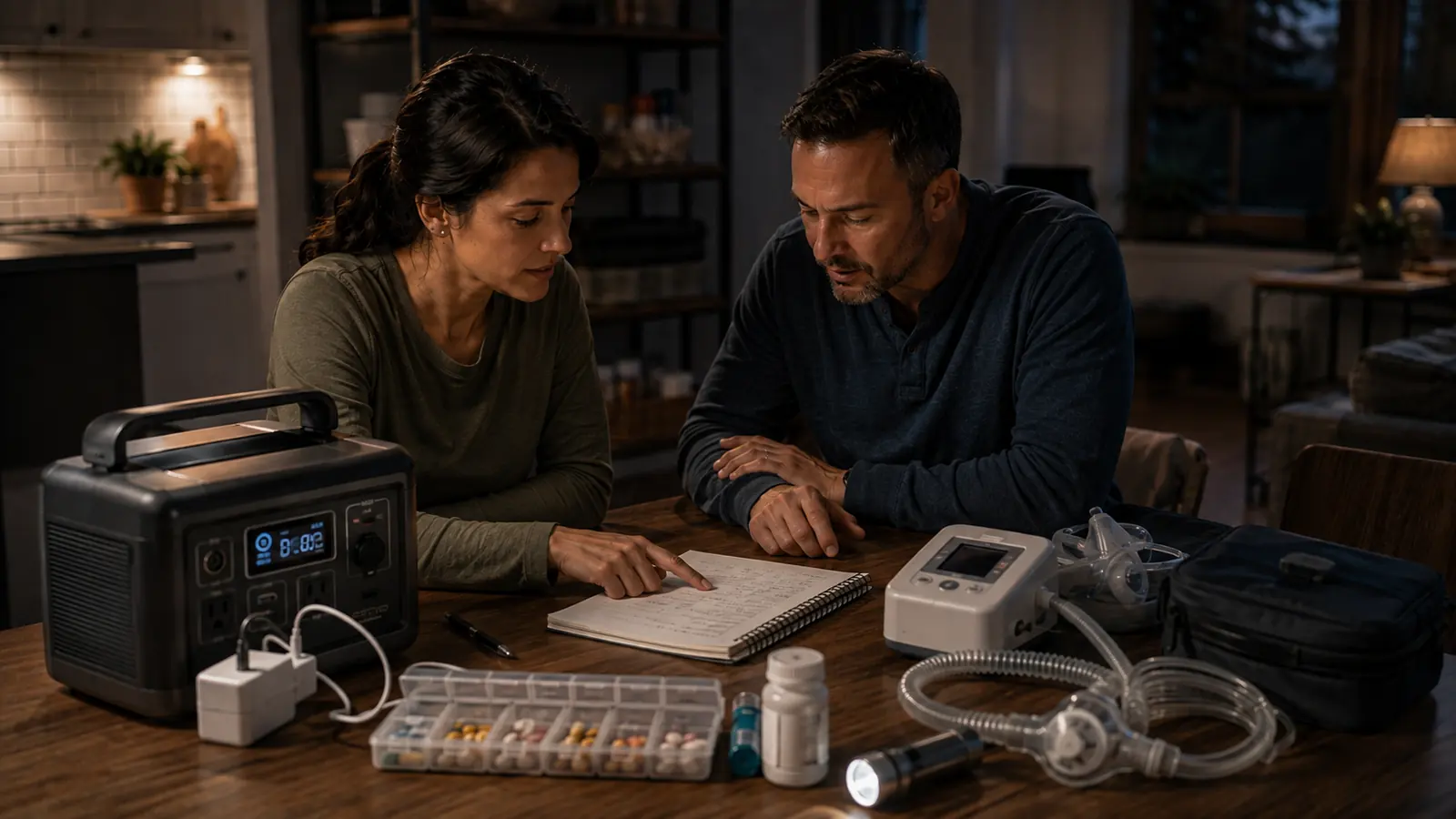
A household that depends on an electrically powered medical device has a different outage risk from a household that mainly wants lights and phone charging. The plan must start with the device, the medical need and instructions from the healthcare team or manufacturer—not with a generic power-station size chart.
FDA provides specific resources for home medical-device users preparing for power outages. It recommends understanding whether a device needs electricity, batteries, running water, telephone or computer connections, keeping instructions available, and knowing whom to contact for help.
Know when to seek immediate help
If required life-sustaining support cannot continue safely and no approved backup is available, seek emergency assistance immediately rather than waiting for the battery to reach zero. Call 911 for a health emergency, including trouble breathing, chest pain or new confusion. The FDA lists these emergency symptoms in its home infusion-pump guidance.
Before an outage, ask the care team to write down the latest safe time to begin transport or contact support. Include travel time, a delay allowance and the power needed while moving. For a non-emergency equipment or supply problem, use the provider’s after-hours contact promptly. A utility registration or estimated restoration time is not a substitute for this plan.
Make a device information sheet
Write down the device name, model, power requirements, supplier, manufacturer support number, healthcare provider and any home-care agency involved. Include the local power utility and emergency contacts. Keep this information in paper form as well as digitally.
If the device has settings that could reset after power is restored, note the prescribed settings and the correct verification process. Do not change medical-device settings based on an internet article.
Ask the manufacturer what backup options are approved
Some devices can use internal batteries, external battery packs, specific DC adapters, uninterruptible power supplies or generator power. Others have limits on voltage quality, grounding, charging or transfer time. Contact the manufacturer or supplier to learn what is compatible with the exact model.
A consumer power station that has enough watt-hours on paper is not automatically an approved medical backup source. The device may have startup loads, waveform requirements or safety instructions that change the answer.
Calculate runtime conservatively
Once the manufacturer confirms an acceptable backup method, estimate how long the device must operate and include conversion losses and reserve capacity. If the medical need cannot tolerate an unexpected shutdown, build redundancy rather than planning to use a battery to zero percent.
Test non-medical parts of the plan before an emergency, such as how to connect the approved backup source, where cables run and how the battery is recharged. Any test involving the medical device itself should follow provider and manufacturer guidance.
Contact the electric utility before an outage
FDA disaster guidance advises notifying the electric company and fire department if you use a medical device that requires power. Some utilities or local agencies maintain programs for customers with medical needs, but enrollment does not guarantee uninterrupted service or priority restoration. Treat it as an additional resource, not the only backup plan.
Plan for relocation
If safe backup power cannot support the required duration, decide in advance where the person can go. That may be a hospital, shelter with appropriate capabilities, family member’s home, hotel or another facility depending on medical needs and local arrangements. Confirm accessibility and power availability rather than assuming a general shelter can support every device.
Medication and supplies matter too
Maintain the medication and disposable supplies recommended by healthcare providers. Record prescription information and pharmacy contacts. Some medicines need refrigeration or temperature control, so the plan must address that separately. Never use a cooler, freezer pack or improvised storage method for medication without knowing the product’s storage requirements.
Protect devices from water and contamination
Floods, leaks and high humidity can damage electrical medical equipment. FDA advises checking for water before plugging in devices and keeping equipment in a clean, secure location. If a device becomes wet or contaminated, follow manufacturer or healthcare instructions before use.
Generator use adds carbon-monoxide risk
If a portable generator is an approved part of the power plan, operate it outdoors more than 20 feet from windows, doors and vents and use working CO alarms, consistent with CDC guidance. Never place a generator in a garage or indoors because the medical need is urgent. Unsafe generator use can create a second emergency.
Keep a communication backup
Store provider, supplier, pharmacy and emergency numbers on paper. Plan for phone charging and an out-of-area household contact. If a service provider normally delivers oxygen, supplies or home care, ask what their emergency continuity plan is.
The correct backup-power plan is device-specific and patient-specific. Use PrepMorrow to organize the household dependencies, but confirm medical-device operation and backup methods with the healthcare team, supplier and manufacturer.
Review after every equipment change
A replacement device, new prescription, changed dose or different battery can invalidate the old plan. Recheck power needs, contact information and backup procedures whenever equipment changes. Keep the plan close to the device where another caregiver could find it.
Build at least two failure paths
Ask what happens if the primary battery fails, if the charger is unavailable, if the outage lasts longer than expected, and if you must leave the home. Depending on the device and medical situation, backups might include a second approved battery, a different approved power source, relocation or an alternative treatment plan provided by the healthcare team. The correct redundancy is medical guidance, not guesswork.
Label power equipment so another caregiver can use it
If a spouse, neighbor or caregiver might need to connect backup power, keep clear written instructions with the approved equipment. Mark which outlet or cable belongs to which device. Do not rely on someone remembering a verbal explanation during a stressful outage.
Temperature-sensitive medication deserves its own plan
Some medicines and supplies have specific storage ranges. Ask the pharmacist or manufacturer how long the product can remain outside refrigeration and what cooling methods are acceptable. A freezer pack placed directly against medication can sometimes cause freezing damage, so improvised cooling should not replace product-specific instructions.
Know when to leave rather than stretch the backup
If remaining battery runtime is approaching the minimum required for safe relocation, act early. Waiting until the final minutes of battery life can make transportation and medical coordination harder. Discuss relocation triggers with the healthcare team and local emergency resources before an outage occurs.
Keep the plan visible to emergency responders
Consider a clearly labeled emergency-information sheet near the device or in a household medical folder. It can list the device, prescribed settings, allergies, medication, supplier and provider contacts without exposing unnecessary personal information. If emergency responders arrive when the usual caregiver is unavailable, concise accurate information can help them understand the dependency more quickly.
Device-by-device backup worksheet
Complete one row per essential device with the treating team or manufacturer, rather than assuming all devices accept the same power source.
| Record | What to verify |
|---|---|
| Device and model | Exact name, power supply, approved backup connection |
| Critical use window | When interruption becomes unsafe; ask the care team |
| Power demand | Measured energy for the actual settings and accessories |
| Backup and recharge | Compatible backup, tested duration and independent fallback |
| Relocation trigger | Who to call, where to go and when to leave |
Do not treat a generic runtime calculator as validation of a life-sustaining device. Get device-specific instructions and test the complete arrangement before relying on it.
Related planning decisions: Can a Power Station Run a CPAP Overnight and How Much Battery Capacity Do You Need for a CPAP.
Medical escalation clarification reviewed October 12, 2026. The outage response must follow the individual care plan and device instructions; the cited FDA pump guidance supplies examples of emergency symptoms, not a CPAP treatment protocol.
Sources & references
PrepMorrow prioritizes authoritative U.S. guidance for safety-critical preparedness information. Sources were reviewed for this guide before publication.