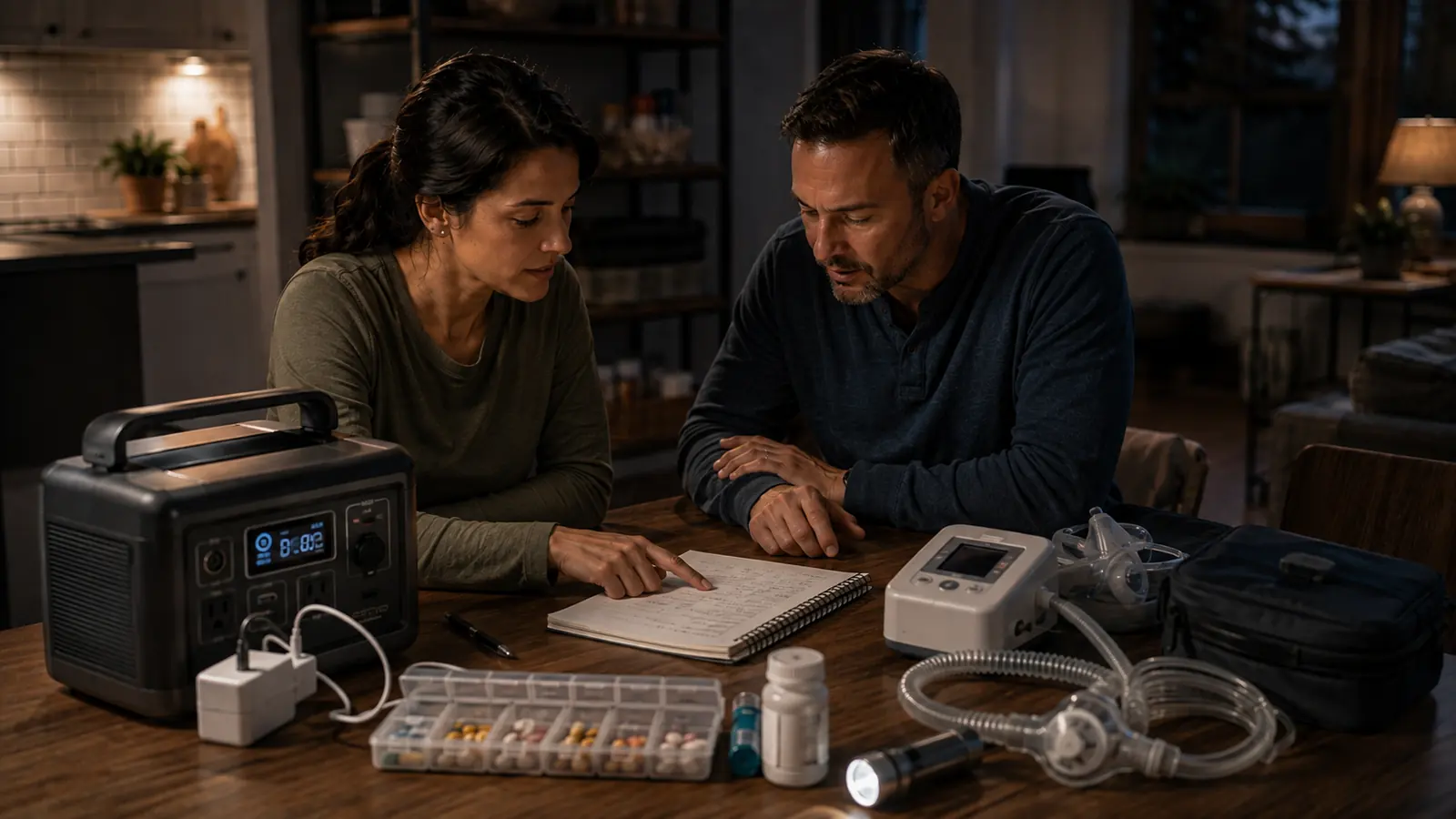
CPAP backup planning is not simply a matter of buying the largest battery you can afford. The useful question is how much energy your specific device uses over a typical night, what accessories are enabled, how many nights you need to cover, and whether you have a medically appropriate contingency plan if the battery cannot be recharged. Because CPAP is a medical device, PrepMorrow treats product sizing as secondary to device-specific instructions and your healthcare plan.
Start with your exact device, not a generic CPAP wattage
CPAP and bilevel devices vary by model, pressure settings, heated humidifier, heated tube, mask leak, climate settings and power-supply efficiency. The safest planning input is the manufacturer’s documented power requirement or measured energy use for the exact configuration you expect to use during an outage. Avoid relying on a generic ‘CPAP uses X watts’ claim as if it applied to every device.
If the manufacturer offers a DC power option or an approved battery solution, review that documentation before improvising. FDA guidance for electrically powered home medical devices emphasizes planning for outages in advance, knowing how long backup power will last and having a response plan if power is not restored.
Watts and watt-hours answer different questions
Watts describe instantaneous power demand. Watt-hours describe energy over time. A device averaging 40 watts for eight hours would use about 320Wh before conversion losses. A device averaging 70 watts for eight hours would use about 560Wh. These are arithmetic examples, not universal CPAP consumption figures. Your real input should come from your device.
A battery labeled 500Wh does not necessarily provide 500Wh of usable AC energy. Inverter conversion, standby power, battery-management limits and temperature can reduce delivered energy. If the device can safely use a manufacturer-approved DC connection, conversion losses may differ, but compatibility must be confirmed rather than assumed.
Humidifier and heated tubing can change the plan
Heating water and tubing requires energy. For some setups, heated humidification can be one of the largest parts of the overnight load. Whether it is clinically acceptable for you to reduce or disable heating is a question for the device instructions and your clinician, not a generic battery-saving recommendation. Build your emergency plan around the configuration you are actually able to use.
If you want two scenarios, calculate one with your normal settings and a second only if you already know a lower-power configuration is acceptable. Do not count on discovering a new operating mode during the outage itself.
How to estimate a capacity target
Once you have a credible nightly Wh estimate, multiply it by the number of nights you want to cover. Then allow for conversion losses and a reserve. For example, if your measured load is 350Wh per night and you want two nights, the devices alone require about 700Wh. A station with 700Wh on the label would usually be too close because the full rated capacity is not delivered to the AC outlet. Planning with a usable-energy factor makes the margin visible.
The target should also include any other critical loads sharing the station. Phone charging may be small, but an oxygen concentrator, refrigerated medication device or room climate equipment can dominate the energy budget. Treat each medical load as its own requirement rather than hiding everything inside one optimistic total.
Recharge strategy matters as much as battery size
A one-night battery may be adequate for a short planned outage if you have a reliable way to recharge it before the next sleep period. The same battery may be inadequate in a multi-day winter storm if solar production is poor, roads are blocked or the utility restoration time is unknown. Think in terms of energy in and energy out per day, not only battery capacity on day one.
If solar is part of the plan, verify the station’s solar input limits, connector requirements and realistic weather exposure before relying on it. If a vehicle is part of the charging plan, consider fuel availability and carbon-monoxide safety. Backup pathways should be practical in the hazard you are preparing for.
Medical contingency planning comes first
FDA and CDC preparedness guidance both support advance planning for people who depend on electricity for medical needs. Know whom to contact, whether your utility offers a medical-needs notification program, whether relocation is part of your plan, and what to do if your backup source fails. Keep relevant device information and contact numbers accessible even if internet service is down.
Do not interpret a runtime estimate as a medical assurance. Batteries can be depleted, damaged, left uncharged or affected by temperature. A robust plan includes redundancy and a decision point for seeking a powered location when required.
Common mistakes
Common errors include sizing from the power brick’s maximum rating instead of actual nightly use, ignoring the heated humidifier, assuming every watt-hour on the battery label is usable, and planning only for one night without a recharge strategy. Another mistake is buying a station before confirming that the device and chosen output method are compatible.
The better order is medical plan first, device data second, nightly energy estimate third, capacity/recharge planning fourth, and product comparison last.
Use a one-night test before the emergency
If you already own the backup battery or power station, a controlled overnight test can reveal far more than a generic wattage table. Begin with the battery fully charged, use the CPAP in the same configuration you normally use, and record the starting and ending battery percentage or delivered energy if the device reports it. Do not perform a test that would leave you without an appropriate backup for a medically necessary device.
Repeatability matters. One night can be affected by unusual temperature, humidifier demand or sleep duration, so use the result as planning evidence rather than a guaranteed minimum. The objective is to understand your own configuration before an outage forces you to learn under pressure.
Why a larger battery is not always the only answer
Capacity is only one part of resilience. A smaller battery with a reliable daytime recharge path may cover repeated nights better than a much larger battery with no practical way to recharge. Conversely, a recharge plan that depends on clear weather may be weak for a storm-related outage. Match the recharge method to the hazard.
Portability can matter as well. If relocation to a powered shelter, hotel, family member or medical facility is part of the contingency plan, a battery that can be transported with the device may be more useful than a very large unit that stays in one room.
Keep device records with the power plan
Store the device model, power-supply information, clinician or provider contact information, supplier details and any manufacturer battery guidance with your emergency documents. A paper copy can still be useful when internet access is disrupted. If replacement tubing, masks, filters or water for humidification are required, those supplies belong in the same medical-preparedness plan.
Also review your broader emergency medication preparedness. Power-dependent equipment and medication needs often overlap during the same outage, and planning them separately can hide shared dependencies such as refrigeration, transportation or caregiver support.
Explore the full topic
Continue through the Medical & Special-Needs Preparedness hub for related planning tools, guides and decision paths.
Build a device-specific CPAP backup worksheet
Record the CPAP model, prescribed setup, humidifier and heated-tube settings, manufacturer power requirements, connector and permitted DC options. Test the exact backup under supervision and track energy use for a representative night. Confirm any backup approach with the device manufacturer or clinical team; an estimated watt-hour calculation is not a guarantee that essential treatment will continue.
Validate CPAP support before choosing a battery
Your prescribed therapy and the device maker’s compatible power options come before a generic Wh target. Build a backup and escalation plan using the medical-device outage guide. The runtime calculator can help with a first estimate using the actual device configuration, but it does not verify compatibility or medically adequate runtime.
Set an action point before the energy reserve is spent
Ask the treating team when to contact support or move to an alternate location if your approved CPAP power plan fails. The remaining energy must cover the agreed response, not only the next minutes of device operation. Do not treat one past overnight test as a medically guaranteed duration.
Keep the device supplier and clinical after-hours contacts in the device-specific outage plan. Use emergency services for an immediate health emergency; routine battery sizing belongs with the care team and manufacturer.
Medical escalation clarification reviewed October 12, 2026. The outage response must follow the individual care plan and device instructions; the cited FDA pump guidance supplies examples of emergency symptoms, not a CPAP treatment protocol.
Sources & references
PrepMorrow prioritizes authoritative U.S. guidance for safety-critical preparedness information. Sources were reviewed for this guide before publication.