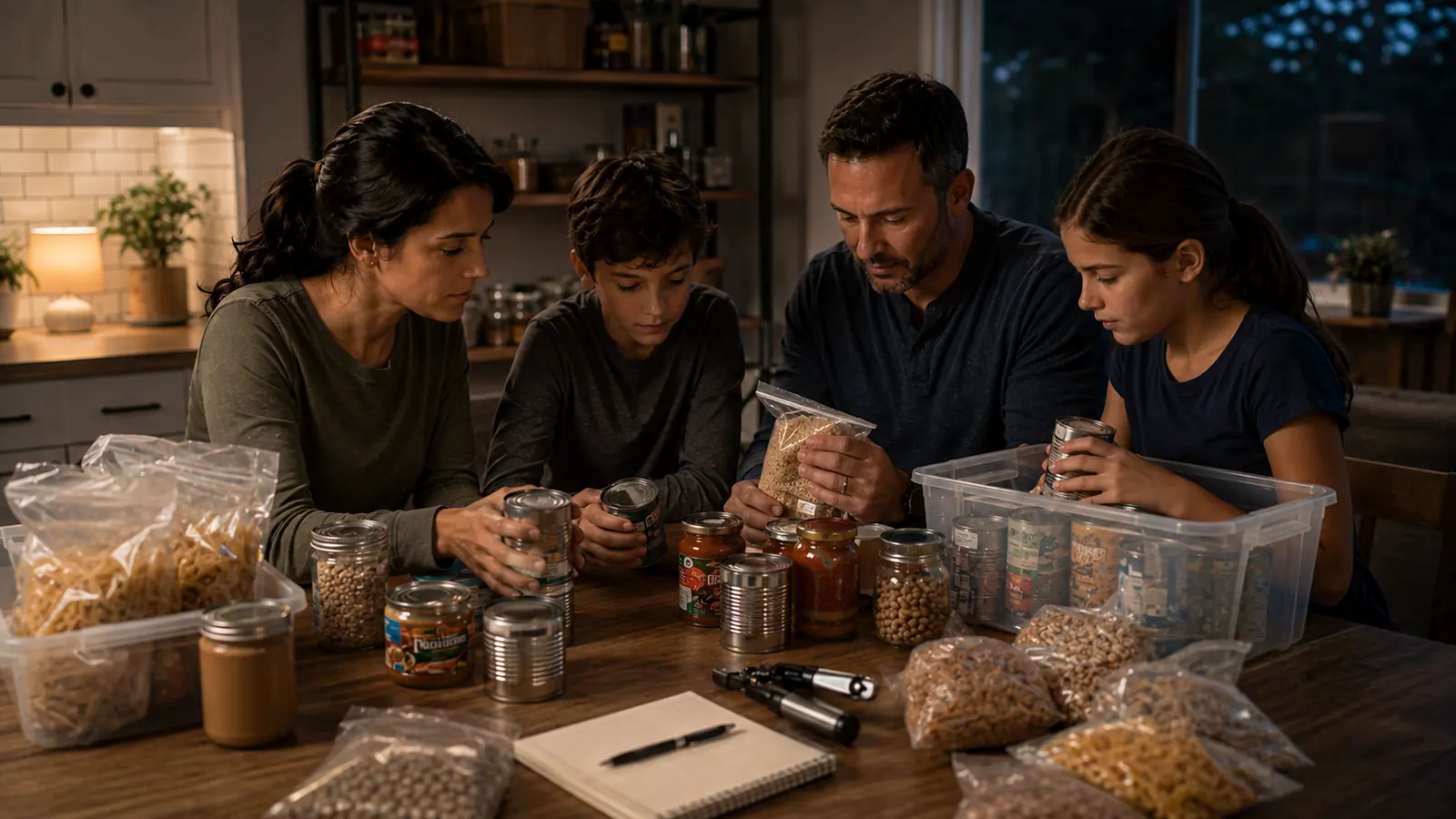
Quick answer: Count everyone who will eat from the reserve, choose how many days you want to cover, and turn that total into actual meals. Four people for seven days need 28 person-days of food; at three meals per day, that means 84 individual meal portions, plus snacks and any special foods. A meal portion is not the same thing as a serving printed on a package.
The American Red Cross recommends non-perishable, easy-to-prepare food for three days when evacuating and two weeks at home. If that feels out of reach, build a usable three-day reserve first and extend it as your budget and storage allow. Local instructions and household needs may change your target.
Calculate people, days and meals
Use two calculations: people × days = person-days, then person-days × meals per day = individual meal portions. Three meals per day is the bookkeeping assumption in the examples below, not a nutritional rule. Include anyone you expect to shelter, such as a relative or caregiver.
| People | Days | Person-days | Individual meal portions |
|---|---|---|---|
| 1 | 3 | 3 | 9 |
| 2 | 3 | 6 | 18 |
| 4 | 7 | 28 | 84 |
| 4 | 14 | 56 | 168 |
Do not divide a kit’s advertised “servings” by three and assume the result is days of food. A serving might be a drink, a small side dish or only part of a meal. Check what is included, the calories per serving and the preparation requirements. Use your household’s normal meals and relevant dietary advice to judge whether a planned day is adequate.
Worked example: four people for seven days
Write a one-day menu that all four people can eat, then repeat or vary it across seven days. You need 28 breakfast portions, 28 lunch portions and 28 dinner portions. Count snacks separately rather than using them to hide a missing meal.
- Breakfast: choose enough familiar cereal, shelf-stable milk in suitable pack sizes, fruit or other foods for four breakfasts each day.
- Lunch: plan a complete no-cook combination, such as ready-to-eat beans or fish, crackers and fruit, with suitable alternatives for allergies and preferences.
- Dinner: include a ready-to-eat option even if you also store meals that need heating. If a meal depends on cooking, count its water and fuel requirements.
Now translate the menu into packages. If your household actually uses two cans of beans in one four-person meal, seven repetitions require 14 cans. That is an example of package arithmetic, not a claim that beans alone make an adequate meal. Count the rest of the menu too, and check real package sizes before buying.
For a longer shopping and rotation plan, continue with building a seven-day emergency food supply. For choosing ingredients, see the best types of food to store for a power outage.
Subtract only food you can actually use
Your normal pantry can cover part of the target. Count unopened shelf-stable food that fits the menu, is stored as directed and will still be available when needed. If you routinely eat through a shelf each week, keep a minimum reserve there or that food may disappear before the outage.
Do not count the refrigerator or freezer as the dependable base of a shelf-stable reserve. Those foods may be usable early in an outage, but their safety depends on time and temperature. Never taste questionable food to decide whether it is safe. Keep that decision separate from the quantity calculation; use the power-outage food safety guide.
For example, if your target is 84 individual meal portions and the pantry already covers 30 complete, usable portions, the remaining gap is 54. Record whether the gap is breakfast, lunch or dinner: 54 portions of one snack do not necessarily fill it.
Check water, preparation and opened packages
Put foods that work without power in a clearly identified part of the reserve. Keep a manual can opener with canned food. Dry rice, pasta and dehydrated meals should count as usable only when the water, preparation equipment and safe cooking method are also available.
Choose package sizes you can finish at one meal if you cannot refrigerate leftovers. Shelf-stable milk, for example, may need refrigeration after opening; read the label. A large container is not automatically more useful than several smaller ones.
Never bring outdoor grills or camping stoves indoors to make stored food usable. Review cooking without power safely before counting meals that depend on fuel-burning equipment. Food quantities do not override evacuation orders or make an unsafe home safe.
Count special foods separately
Include foods that meet allergies, dietary restrictions, texture needs and medication-related eating routines. A household total can look sufficient while leaving one person without suitable meals. For medically prescribed diets, use the person’s existing care instructions rather than a generic emergency menu.
For infants, plan the feeding supplies appropriate to their current routine and the safe water and cleaning they require. Count pet food in its own inventory using the pet’s usual daily amount; it is not part of the human meal total.
Keep the reserve at its target
Use older stock in ordinary meals and replace it so the reserve stays above your chosen minimum. Follow package storage directions, inspect packaging and review the menu when household needs change. Recount after using emergency supplies.
The next useful step is a one-page inventory: people covered, days covered, meals planned, packages already on hand and packages still needed. Continue through the Emergency Food & Cooking hub for the wider food and preparation plan.
Sources & references
Reviewed October 12, 2026. The duration recommendation above comes from the American Red Cross; food-safety cautions follow CDC guidance. The meal table and package calculations are PrepMorrow planning examples, not official ration standards.
- Ready.gov — Preparing Makes Sense: Build a Kit — existing reference retained; this document could not be retrieved during this review.
- American Red Cross — What Do You Need in a Survival Kit? — food duration and kit guidance.
- CDC — Keep Food Safe After a Disaster or Emergency — power-outage food safety and the warning against tasting food to judge safety.