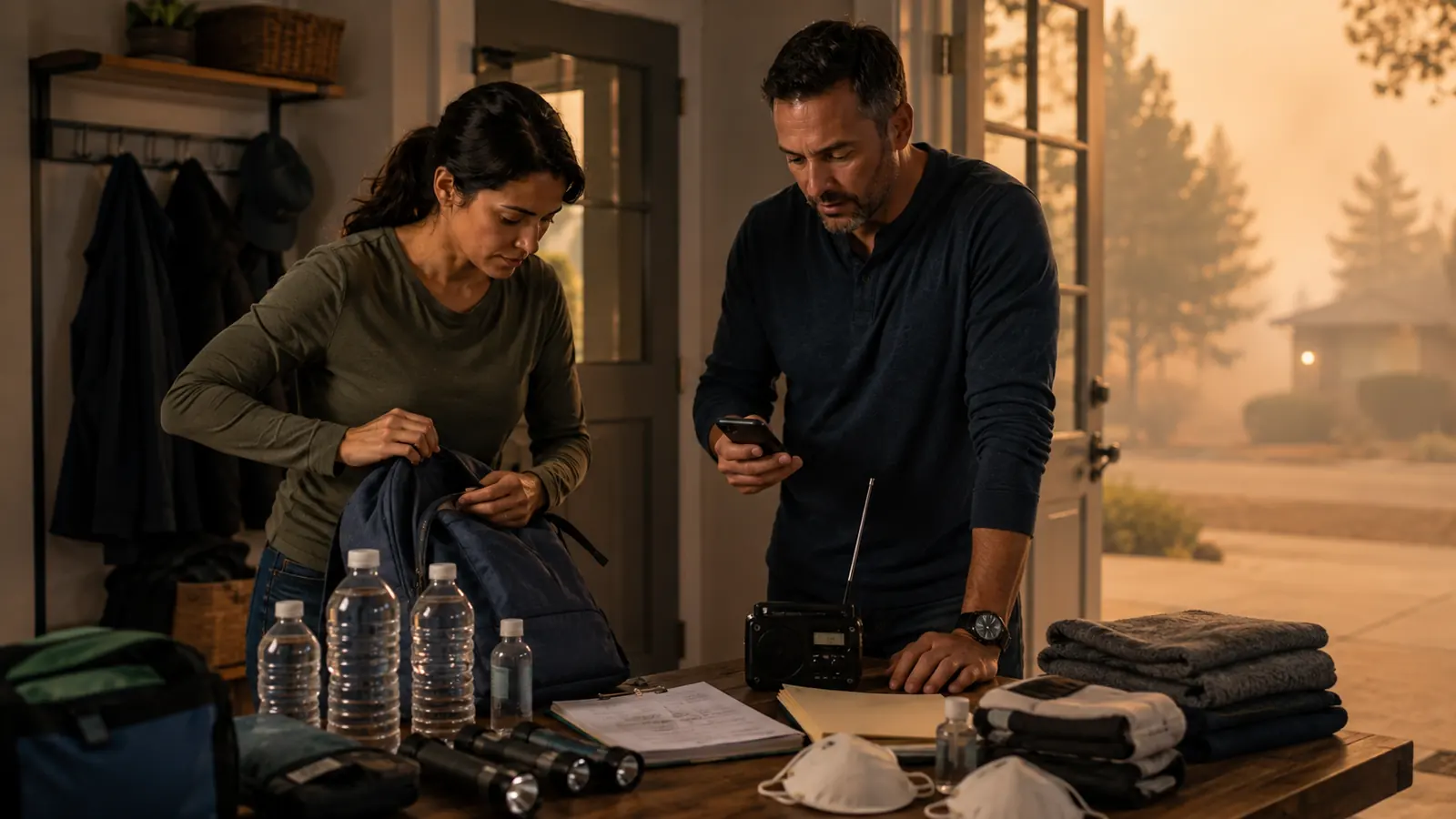
Wildfire preparedness is different from a long-duration shelter-in-place plan because the central question may become: how quickly can the household leave? Roads can close, smoke can reduce visibility and air quality, and evacuation orders may change rapidly as wind shifts. A good plan therefore emphasizes alerts, routes, transportation and a compact set of essentials that can move with you.
Ready.gov advises households in wildfire-prone areas to know multiple evacuation routes, sign up for local warning systems and leave immediately when authorities say to evacuate. Waiting until flames are visible can remove the time and route options the plan was meant to protect.
Wildfire departure triggers
- Before the season: Know at least two routes, prepare transport for pets, keep an essentials bag accessible and subscribe to local alerts.
- Nearby fire or deteriorating air: Check authoritative local notices, charge phones, fuel or charge vehicles, and move essential items into ready-to-leave positions.
- Evacuation order or immediate danger: Leave promptly on the instructed route. Do not delay to finish packing or protect replaceable property.
Wildfire smoke can be dangerous even when flames are far away. Use local air-quality and public-health guidance for indoor air and respirator decisions.
Know more than one way out
Drive potential evacuation routes before wildfire season. Identify roads that may bottleneck, gates that can close, bridges, steep terrain and alternatives if the most obvious route is blocked. If your household has only one practical road, understand that limitation and pay especially close attention to early warnings.
Include the destination question: where can you go with children, pets, service animals or livestock? A route without a realistic destination is only half a plan.
Build an alert stack
Use local emergency alerts, Wireless Emergency Alerts, the FEMA app where useful, NOAA Weather Radio and trusted local authorities. Do not rely only on seeing or smelling smoke. At night or during a fast-moving fire, visual confirmation can come too late.
Make sure more than one adult knows how alerts arrive and what terminology local agencies use for evacuation warnings and orders.
Keep the go-bag practical
A wildfire go-bag should support safe movement rather than become a heavy camping inventory. Prioritize identification, medication, essential medical supplies, phone charging, water, simple food, flashlight, basic hygiene, contact information, copies of key documents, pet supplies and weather-appropriate clothing.
Ready.gov wildfire guidance also recommends N95 respirator masks to reduce exposure to airborne particles. An N95 does not make dangerous fire conditions safe and does not protect against all gases; it is a smoke-particle control layer while you follow evacuation and public-health instructions.
Prepare the vehicle
Keep enough fuel or charge to leave without first joining a long line at a station. Store the go-bag where it can be loaded quickly. If your region is under elevated fire weather, avoid letting the vehicle become nearly empty. Maintain basic emergency items, but do not turn the vehicle into a permanent high-temperature storage location for medicines or other items that can be damaged by heat.
Plan for pets before the order
Locate carriers, leashes, food, medication and vaccination or ownership information. Know which shelters, hotels, friends or family locations can accept animals. A frightened pet that must be found and caught during an evacuation can consume critical time.
Reduce hazards around the home when there is time
Ready.gov recommends creating defensible space by removing leaves, debris and flammable material near the home and using fire-resistant approaches to maintenance and renovation. Local fire agencies may provide more detailed zone guidance appropriate to vegetation and construction in your area.
These property steps reduce risk but do not justify ignoring an evacuation order. The home may be more defensible; people still need to leave when authorities direct them to.
Protect documents and insurance information
Keep essential records in a fire-resistant or otherwise protected location and maintain secure digital copies. Photograph property and important belongings periodically so a current inventory exists before a disaster. Review insurance coverage before wildfire season rather than after a loss.
Smoke can affect people far from the flames
Wildfire smoke can travel long distances. People with heart or lung disease, older adults, children and pregnant people may be more vulnerable. Follow air-quality and public-health recommendations for your area. A portable air cleaner can be useful in some homes, but it is not a substitute for evacuation from a fire-threatened area.
After the fire
Return only when authorities say it is safe. Hot ash, smoldering debris and damaged trees can remain hazardous. Wear appropriate protective equipment during cleanup and keep pets away from hot ground and debris. Listen for drinking-water advisories if infrastructure was damaged.
The best time to decide what leaves with you is before the evacuation order. When the order arrives, execute the plan instead of repacking the house.
Use Prep Check to personalize the plan
Wildfire risk adds evacuation, smoke, transport and document needs to the core preparedness baseline. Households with medication, medical devices, pets or mobility limitations should move those considerations near the top of the plan rather than treating them as optional additions.
Build a departure trigger before stress takes over
Households sometimes wait because they are unsure whether conditions are “bad enough.” Use official evacuation terminology and local guidance as the trigger. If someone in the household has limited mobility, respiratory disease, needs medical equipment or requires extra loading time, consider whether your personal departure threshold should be earlier than the general population’s.
Keep indoor air as clean as practical during smoke events
When there is smoke but no evacuation order for your location, close windows and doors if outdoor air is poor and use air-conditioning or filtration in a mode that limits outdoor smoke where appropriate. Check local air-quality guidance. A properly sized portable air cleaner can reduce indoor particles in a closed room, but it cannot make a home safe from an approaching wildfire.
Know what not to pack at the last minute
Large collections, bulky gear and replaceable household goods should not delay evacuation. Keep the truly important items—medication, identification, essential documents, communication gear, pet equipment and a small amount of food and water—organized in advance. If there is room and time, additional comfort items can be added after the core is loaded.
Plan for a power outage even if the fire never reaches the home
Utilities may intentionally shut off electricity during extreme fire weather or lines may be damaged. Keep lighting, phone charging and medically necessary backup plans ready. Generator safety rules still apply during wildfire conditions, and local fire restrictions can affect whether certain equipment should be operated.
For a closely related household decision, see Hurricane Preparedness Guide for U.S. Households.
Sources & references
PrepMorrow prioritizes authoritative U.S. guidance for safety-critical preparedness information. Sources were reviewed for this guide before publication.